Variolation: Difference between revisions
CSV import |
CSV import |
||
| Line 33: | Line 33: | ||
[[Category:History of medicine]] | [[Category:History of medicine]] | ||
[[Category:Vaccination]] | [[Category:Vaccination]] | ||
== Variolation == | |||
<gallery> | |||
File:Lady_Mary_Wortley_Montagu.jpg|Lady Mary Wortley Montagu | |||
File:Queens_of_Mysore_(detail),_Thomas_Hickey,_1805.jpg|Queens of Mysore (detail), Thomas Hickey, 1805 | |||
</gallery> | |||
Latest revision as of 01:12, 18 February 2025
Historical method of smallpox inoculation
Variolation was an early method of immunization against smallpox, involving the deliberate introduction of material from smallpox sores into the skin of a healthy person. This practice was used before the development of the modern vaccine by Edward Jenner.
History[edit]
The practice of variolation is believed to have originated in China or India as early as the 10th century. It spread to other parts of Asia and Africa before reaching Europe in the early 18th century.
In 1717, Lady Mary Wortley Montagu, the wife of the British ambassador to the Ottoman Empire, observed the practice in Constantinople. She had her own son variolated and later advocated for the procedure in England. Her efforts were instrumental in popularizing variolation in Europe.

Method[edit]
Variolation involved taking material from a smallpox sore and introducing it into a healthy person, usually through a scratch on the arm. The goal was to induce a mild form of the disease, which would then confer immunity against future infections. While variolation reduced the mortality rate compared to natural smallpox infection, it was not without risks, as it could still result in severe illness or death.
Impact and Decline[edit]
Variolation significantly reduced the incidence of smallpox in regions where it was practiced. However, it was eventually replaced by the safer and more effective method of vaccination developed by Edward Jenner in 1796. Jenner's method used material from cowpox lesions, which provided immunity to smallpox without the risk of causing the disease itself.
Cultural and Social Aspects[edit]
Variolation was met with varying degrees of acceptance across different cultures. In some regions, it was embraced as a life-saving procedure, while in others, it faced resistance due to religious or cultural beliefs. The practice also highlighted issues of class and access to medical care, as it was often more readily available to the wealthy.
Related pages[edit]
References[edit]
- Behbehani, A. M. (1983). "The smallpox story: life and death of an old disease." Microbiological Reviews, 47(4), 455-509.
- Riedel, S. (2005). "Edward Jenner and the history of smallpox and vaccination." Baylor University Medical Center Proceedings, 18(1), 21-25.
,_Thomas_Hickey,_1805.jpg)
Variolation[edit]
-
 Lady Mary Wortley Montagu
 -
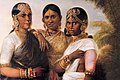 Queens of Mysore (detail), Thomas Hickey, 1805
