Nick (DNA): Difference between revisions
CSV import Tags: mobile edit mobile web edit |
CSV import Tags: mobile edit mobile web edit |
||
| Line 40: | Line 40: | ||
[[Category:Genetics]] | [[Category:Genetics]] | ||
[[Category:Bacteriology]] | [[Category:Bacteriology]] | ||
<gallery> | |||
File:Effects_of_nicks_on_intersecting_DNA_forms.png|Effects of nicks on intersecting DNA forms | |||
File:Ligase_nick_repair_mecanism.jpg|Ligase nick repair mechanism | |||
</gallery> | |||
Latest revision as of 00:48, 18 February 2025
Nick (DNA) in Bacteria[edit]
A nick in DNA refers to a break in one of the two strands of the DNA double helix. This break involves the disruption of the phosphodiester bond between adjacent nucleotides, leaving the sugar-phosphate backbone of one strand intact while the other strand is severed. Nicks are significant in various biological processes, particularly in bacteria, where they play crucial roles in DNA replication, DNA repair, and genetic recombination.
DNA Replication[edit]
In bacterial DNA replication, nicks are essential for the initiation and progression of the replication process. The bacterial chromosome is typically circular, and replication begins at a specific location known as the origin of replication. During replication, the enzyme DNA helicase unwinds the double helix, creating a replication fork. As the replication machinery progresses, DNA polymerase synthesizes new DNA strands by adding nucleotides complementary to the template strand.
Nicks are introduced by DNA primase, which synthesizes short RNA primers that provide a starting point for DNA polymerase. These RNA primers are later removed, and the resulting gaps are filled by DNA polymerase. The enzyme DNA ligase then seals the nicks by forming phosphodiester bonds, completing the replication process.
DNA Repair[edit]
Nicks also play a critical role in bacterial DNA repair mechanisms. One of the primary repair pathways is base excision repair (BER), which corrects small, non-helix-distorting base lesions. In BER, a DNA glycosylase recognizes and removes the damaged base, creating an abasic site. An AP endonuclease then cleaves the DNA backbone at the abasic site, generating a nick.
The nick is further processed by DNA polymerase I, which removes the damaged region and fills in the gap with new nucleotides. Finally, DNA ligase seals the nick, restoring the integrity of the DNA molecule.
Genetic Recombination[edit]
In bacteria, genetic recombination is a process that allows for the exchange of genetic material between different DNA molecules, contributing to genetic diversity. Nicks are involved in homologous recombination, a type of genetic recombination that occurs between homologous DNA sequences.
During homologous recombination, the enzyme RecBCD processes double-strand breaks to produce single-stranded DNA with nicks. The single-stranded DNA invades a homologous DNA molecule, forming a D-loop structure. The enzyme RecA facilitates the strand exchange, allowing for the pairing of homologous sequences. Nicks are then sealed by DNA ligase, completing the recombination process.
Conclusion[edit]
Nicks in DNA are vital for various cellular processes in bacteria, including DNA replication, repair, and recombination. These processes ensure the maintenance of genetic information and contribute to the adaptability and survival of bacterial species.
See Also[edit]
References[edit]
- Alberts, B., Johnson, A., Lewis, J., Raff, M., Roberts, K., & Walter, P. (2002). Molecular Biology of the Cell. Garland Science.
- Lodish, H., Berk, A., Kaiser, C. A., Krieger, M., Bretscher, A., Ploegh, H., Amon, A., & Scott, M. P. (2016). Molecular Cell Biology. W. H. Freeman.
-
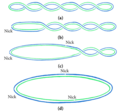 Effects of nicks on intersecting DNA forms
 -
 Ligase nick repair mechanism


