Blastocoel: Difference between revisions
CSV import |
CSV import |
||
| Line 37: | Line 37: | ||
{{biology-stub}} | {{biology-stub}} | ||
<gallery> | |||
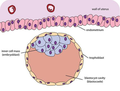
File:Diagram of Blastocyst stage.png|Blastocoel | |||
</gallery> | |||
Latest revision as of 00:59, 20 February 2025
| General Information | |
|---|---|
| Latin | blastocoelum |
| Greek | |
| TA98 | |
| TA2 | |
| FMA | |
| Details | |
| System | |
| Artery | |
| Vein | |
| Nerve | |
| Lymphatic drainage | |
| Precursor | |
| Function | |
| Identifiers | |
| Clinical significance | |
| Notes | |
The blastocoel is a fluid-filled cavity that forms within the blastula during the early stages of embryonic development in animals. This cavity is crucial for the structural integrity and the differentiation processes of the developing embryo.
Structure[edit]
The blastocoel is located at the center of the blastula, a spherical layer of cells known as the blastoderm. The cavity is filled with a fluid that helps maintain the pressure needed to support the cellular structure, preventing the blastula from collapsing.
Function[edit]
The primary function of the blastocoel is to provide a space that separates the cells of the blastoderm from those that will form the endoderm and ectoderm. This separation is essential for the proper organization and layering of tissues in later stages of development. Additionally, the fluid within the blastocoel allows for the diffusion of nutrients and waste products between cells.
Development[edit]
The formation of the blastocoel begins with the process of cleavage, where the fertilized egg divides to form a multicellular structure. As cleavage continues, cells rearrange themselves to form a hollow sphere, with the blastocoel emerging in the center. The size and shape of the blastocoel can vary significantly among different species.
Clinical Significance[edit]
While primarily a feature of early development, understanding the dynamics of the blastocoel can be important in medical fields such as reproductive technology and developmental biology. Studies of the blastocoel can provide insights into the mechanisms of tissue formation and the effects of genetic or environmental factors on embryonic development.
See Also[edit]

-
 Blastocoel

