New Left: Difference between revisions
CSV import |
CSV import |
||
| Line 29: | Line 29: | ||
{{politics-stub}} | {{politics-stub}} | ||
<gallery> | |||
File:Herbert_Marcuse_in_Newton,_Massachusetts_1955.jpeg|Herbert Marcuse in Newton, Massachusetts, 1955 | |||
File:Cover_of_SDS_pamphlet_circa_1966.jpg|Cover of SDS pamphlet circa 1966 | |||
File:Abbie_Hoffman_visiting_the_University_of_Oklahoma_circa_1969.jpg|Abbie Hoffman visiting the University of Oklahoma circa 1969 | |||
File:Vietnamdem.jpg|Vietnam War demonstration | |||
File:Situationist.jpg|Situationist International poster | |||
File:Tokyo_Univercity_of_education19680801.jpg|Tokyo University of Education, August 1, 1968 | |||
</gallery> | |||
Latest revision as of 11:03, 18 February 2025
| Politics |
|---|
|
|
The New Left refers to a range of political movements that emerged in the United States, United Kingdom, and other parts of the Western world during the 1950s and 1960s. These movements sought to address issues such as civil rights, anti-colonialism, and anti-capitalism, distinguishing themselves from the more traditional socialist and communist ideologies of the Old Left. The New Left was characterized by its emphasis on cultural revolution, direct action, and a broader interpretation of political and personal freedom.
Origins[edit]
The term "New Left" was popularized after the release of the New Left Review, a political magazine established in the United Kingdom in 1960. The movement was initially a response to the perceived inadequacies of the Old Left, which was often associated with the Soviet Union's authoritarian model of socialism. The New Left rejected both Western capitalism and Eastern bloc communism, advocating for a new approach to socialism that was more open to democracy and personal freedoms.
Key Issues and Movements[edit]
The New Left covered a broad spectrum of issues, including:
- Civil Rights Movement: In the United States, New Left activists played significant roles in the struggle for African American civil rights and were involved in organizations like the Student Nonviolent Coordinating Committee (SNCC).
- Anti-Vietnam War Movement: Opposition to the Vietnam War was a unifying cause for the New Left globally, leading to widespread protests and demonstrations.
- Women's Liberation Movement: The New Left also intersected with the emergence of the feminist movement, advocating for gender equality and women's rights.
- Environmentalism: Concerns about environmental degradation and the exploitation of natural resources were also integral to New Left ideology.
Influence and Legacy[edit]
The New Left had a lasting impact on political discourse and policy. It influenced various social movements and contributed to the development of identity politics, multiculturalism, and the academic field of cultural studies. Although the New Left declined as a distinct movement by the 1980s, many of its ideas have been absorbed into mainstream political thought.
Criticism[edit]
The New Left faced criticism from various quarters. Traditional leftists often viewed it as too fragmented and lacking in discipline. Conversely, conservative critics accused it of undermining social cohesion and promoting radicalism.
See Also[edit]

-
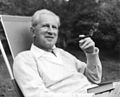 Herbert Marcuse in Newton, Massachusetts, 1955
 -
 Cover of SDS pamphlet circa 1966
 -
 Abbie Hoffman visiting the University of Oklahoma circa 1969
 -
 Vietnam War demonstration
 -
 Situationist International poster
 -
 Tokyo University of Education, August 1, 1968


