Genetically modified crops: Difference between revisions
CSV import |
CSV import |
||
| Line 51: | Line 51: | ||
{{Biotech-stub}} | {{Biotech-stub}} | ||
== Genetically_modified_crops == | |||
<gallery> | |||
File:Transformation_with_Agrobacterium.JPG|Transformation with Agrobacterium | |||
File:Btcornafrica.jpg|Bt corn in Africa | |||
File:Älskade_knöl_–_utflykt_med_SLU_till_deras_potatisförsöksodlingar_–_20190825_09_(cropped).jpg|Potato field trial | |||
File:World_map_GMO_production.svg|World map GMO production | |||
File:Gmo_acreage_world_2009.PNG|GMO acreage world 2009 | |||
</gallery> | |||
Latest revision as of 11:45, 25 February 2025

Genetically modified crops (GMCs) are plants used in agriculture, the DNA of which has been modified using genetic engineering techniques. In most cases, the aim is to introduce a new trait to the plant which does not occur naturally in the species. Examples in food crops include resistance to certain pests, diseases, or environmental conditions, reduction of spoilage, or resistance to chemical treatments (e.g., resistance to a herbicide). Other examples aim to improve the nutrient profile of the crop.
History[edit]
The first genetically modified plant was produced in 1983, using an antibiotic resistance gene. The first commercially grown genetically modified crop was the Flavr Savr tomato, which was engineered to have a longer shelf life. Since then, the adoption of genetically modified crops has grown rapidly, with major crops including soybean, maize, cotton, and canola.
Techniques[edit]
Genetic modification of crops involves several techniques, including:
- **Transgenesis**: The process of introducing an external gene into a plant.
- **Cisgenesis**: The process of introducing a gene from the same species or a closely related one.
- **Gene editing**: Techniques like CRISPR that allow for precise modifications to the plant's DNA.
Benefits[edit]
Genetically modified crops offer several potential benefits:
- **Increased yield**: Crops can be engineered to produce more food per acre.
- **Pest resistance**: Crops can be made resistant to pests, reducing the need for chemical pesticides.
- **Herbicide tolerance**: Crops can be engineered to withstand specific herbicides, making weed control easier.
- **Nutritional enhancement**: Crops can be modified to contain more vitamins and minerals.
Controversies and Concerns[edit]
Despite their benefits, genetically modified crops are subject to controversy and debate. Concerns include:
- **Environmental impact**: Potential for cross-breeding with wild relatives and the development of resistant pests.
- **Health risks**: Potential for allergenicity and long-term health effects.
- **Economic issues**: Market control by a few large biotechnology companies and the impact on small farmers.
Regulation[edit]
The regulation of genetically modified crops varies by country. In the United States, the Food and Drug Administration (FDA), United States Department of Agriculture (USDA), and Environmental Protection Agency (EPA) all play roles in the regulation process. In the European Union, genetically modified crops are subject to strict regulations and labeling requirements.
Examples of Genetically Modified Crops[edit]
- **Bt corn**: Engineered to produce a toxin that is harmful to certain pests.
- **Golden Rice**: Modified to produce beta-carotene, a precursor of vitamin A.
- **Roundup Ready soybeans**: Engineered to be resistant to the herbicide glyphosate.
See Also[edit]
- Genetic engineering
- Transgenic plant
- Biotechnology
- Agricultural biotechnology
- Herbicide resistance
- Pest resistance
- CRISPR
Categories[edit]

This article is a biotechnology stub. You can help WikiMD by expanding it!
Genetically_modified_crops[edit]
-
 Transformation with Agrobacterium
 -
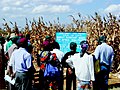 Bt corn in Africa
 -
 Potato field trial
 -
 World map GMO production
 -
 GMO acreage world 2009

.jpg)


