Pesto: Difference between revisions
CSV import |
CSV import |
||
| Line 44: | Line 44: | ||
{{food-stub}} | {{food-stub}} | ||
<gallery> | |||
File:BasilPesto.JPG|Basil Pesto | |||
File:PastaWithPesto.JPG|Pasta with Pesto | |||
File:Ingredienti_per_il_pesto.jpg|Ingredients for Pesto | |||
File:Pasta_al_Pesto_in_Florence,_Italy_(47909905101).jpg|Pasta al Pesto in Florence, Italy | |||
File:Pesto_bread.jpg|Pesto Bread | |||
</gallery> | |||
Latest revision as of 04:39, 18 February 2025
Pesto is a traditional Italian sauce originating from the Liguria region. It is commonly used to add flavor to pasta, bread, and a variety of other dishes. The name "pesto" is derived from the Italian word pestare, which means to pound or crush, reflecting the traditional method of preparation using a mortar and pestle. The classic version of pesto, known as Pesto alla Genovese, is made from fresh basil, garlic, pine nuts, Parmigiano-Reggiano (Parmesan cheese), Pecorino cheese, and olive oil.
Ingredients and Variations[edit]
The primary ingredients of Pesto alla Genovese include:
- Fresh basil leaves
- Garlic
- Pine nuts
- Parmigiano-Reggiano
- Pecorino cheese
- Extra virgin olive oil
These ingredients are traditionally blended together in a mortar and pestle to create a thick, green sauce. However, modern preparations often use a food processor for convenience.
While Pesto alla Genovese is the most recognized form of pesto, there are several regional variations that incorporate different ingredients. For example, Pesto alla Siciliana (or Pesto Rosso) includes tomatoes and less basil, resulting in a red sauce. Another variant, Pesto alla Calabrese, features red peppers and ricotta cheese.
Culinary Uses[edit]
Pesto is versatile in the kitchen and can be used in a variety of dishes:
- As a sauce for pasta, often mixed with pasta water to help it adhere to the noodles
- Spread on bread or sandwiches
- As a base for pizza
- Mixed into salad dressings
- As a marinade for meats and vegetables
Preparation[edit]
To prepare traditional Pesto alla Genovese:
- Combine fresh basil leaves, garlic, and pine nuts in a mortar and pestle or food processor. Crush or blend until coarsely chopped.
- Add grated Parmigiano-Reggiano and Pecorino cheese, continuing to blend.
- Slowly drizzle in olive oil while mixing, until the sauce reaches the desired consistency.
- Season with salt to taste.
Cultural Significance[edit]
Pesto has a rich history in Italian cuisine, particularly in the Liguria region where it originated. It is celebrated for its simplicity and the way it showcases the flavors of fresh, high-quality ingredients. The sauce has gained international popularity, symbolizing the broader appreciation for Italian culinary traditions.
See Also[edit]

-
 Basil Pesto
 -
 Pasta with Pesto
 -
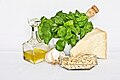 Ingredients for Pesto
 -
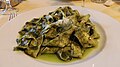 Pasta al Pesto in Florence, Italy
 -
 Pesto Bread


.jpg)

