Cheese crystals: Difference between revisions
CSV import |
CSV import |
||
| Line 24: | Line 24: | ||
{{food-stub}} | {{food-stub}} | ||
<gallery> | |||
File:Parmigiano_800x600.jpg|Cheese Crystals | |||
File:Cheese_Crystals.jpg|Cheese Crystals | |||
</gallery> | |||
Latest revision as of 02:05, 17 February 2025
Cheese crystals are crystalline deposits that can be found in both aged hard and semi-hard cheeses. These crystals add a crunchy texture to the cheese and are often considered a sign of quality and age. The two main types of crystals found in cheese are calcium lactate crystals and tyrosine crystals, each contributing differently to the cheese's texture and flavor.
Formation[edit]
Cheese crystals form during the cheese aging process. As cheese ages, it undergoes a series of biochemical reactions, including the breakdown of proteins and fats. This breakdown process is essential for developing the cheese's flavor and texture. Tyrosine crystals form as a result of the breakdown of the milk protein casein, while calcium lactate crystals result from the precipitation of calcium lactate, which can form when lactic acid (produced during fermentation) reacts with calcium present in the cheese.
Types of Cheese Crystals[edit]
Tyrosine Crystals[edit]
Tyrosine crystals are white or off-white and are found in aged hard cheeses such as Parmigiano-Reggiano, Aged Gouda, and Grana Padano. These crystals are actually amino acid clusters, specifically tyrosine, which precipitate out of the cheese matrix. Their presence is often indicative of a well-aged cheese and contributes to a desirable crunchy texture.
Calcium Lactate Crystals[edit]
Calcium lactate crystals are more commonly found in aged cheddar, Gouda, and other semi-hard cheeses. These crystals can appear on both the inside and the outside of the cheese. On the outside, they can sometimes be mistaken for mold. Inside the cheese, they contribute to the cheese's complex texture. Unlike tyrosine crystals, calcium lactate crystals form from the interaction of lactic acid with calcium, not from protein breakdown.
Culinary and Sensory Aspects[edit]
Cheese crystals are highly valued by cheese connoisseurs for the textural contrast they provide. The crunchiness of the crystals juxtaposed with the creaminess of the cheese creates a complex sensory experience. Furthermore, the presence of these crystals often indicates a cheese that has been aged properly and has developed a depth of flavor.
Misconceptions[edit]
Some consumers mistake cheese crystals for salt granules or signs of spoilage, but these crystals are entirely natural and safe to eat. They are a sign of a cheese's maturity and are sought after by enthusiasts for the unique texture and flavor they add.
Conclusion[edit]
Cheese crystals are a fascinating feature of aged cheeses, contributing to their texture and flavor complexity. Whether they are tyrosine or calcium lactate crystals, their presence is a testament to the cheese's age and the care taken in its production. Appreciating these crystals can enhance the cheese-tasting experience, offering both a tactile and a flavorful delight.

-
 Cheese Crystals
 -
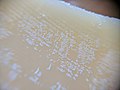 Cheese Crystals


