Kleeblattschaedel: Difference between revisions
CSV import |
CSV import |
||
| Line 31: | Line 31: | ||
{{rarediseases}} | {{rarediseases}} | ||
<gallery> | |||
File:Carpenter_Syndrome_1.jpg|Kleeblattschaedel | |||
File:Crouzon_Syndrome.jpg|Kleeblattschaedel | |||
File:Weygandt_1.jpg|Kleeblattschaedel | |||
File:ABNORMALITIES;_Tabulae_ad_illustrandam_embry_Wellcome_L0032358.jpg|Kleeblattschaedel | |||
</gallery> | |||
Revision as of 04:59, 18 February 2025
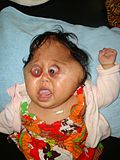
Kleeblattschädel Syndrome (also known as Cloverleaf Skull Syndrome) is a rare congenital disorder characterized by a complex craniosynostosis that results in a cloverleaf-shaped skull. This condition is associated with a fusion of multiple skull bones, which affects the shape of the head and face. Kleeblattschädel Syndrome is a part of a group of disorders known as craniosynostosis syndromes, which involve premature fusion of one or more of the cranial sutures.
Etiology
The exact cause of Kleeblattschädel Syndrome is not fully understood, but it is believed to be related to genetic mutations. It has been associated with mutations in several genes, including the FGFR2 (Fibroblast Growth Factor Receptor 2) and TWIST1 genes. These mutations are thought to affect the development of the skull bones during embryonic development.
Symptoms
The most notable symptom of Kleeblattschädel Syndrome is the cloverleaf-shaped skull. Other symptoms can include:
- Hydrocephalus (accumulation of fluid in the brain)
- Proptosis (bulging of the eyes)
- Midface hypoplasia (underdevelopment of the middle facial structures)
- Intellectual disability
- Respiratory problems
- Hearing loss
Diagnosis
Diagnosis of Kleeblattschädel Syndrome is primarily based on physical examination and imaging studies, such as X-rays and MRI (Magnetic Resonance Imaging). These imaging techniques can help in assessing the extent of craniosynostosis and other associated abnormalities.
Treatment
Treatment of Kleeblattschädel Syndrome is complex and often requires a multidisciplinary approach. Surgical intervention is typically necessary to correct the shape of the skull and alleviate increased intracranial pressure. Multiple surgeries may be required as the child grows. Management also includes treatment of associated conditions, such as hydrocephalus, which may require the placement of a ventriculoperitoneal shunt.
Prognosis
The prognosis for individuals with Kleeblattschädel Syndrome varies depending on the severity of the condition and the presence of associated anomalies. Early and aggressive treatment can improve outcomes, but the condition can be life-threatening, especially in severe cases.
Epidemiology
Kleeblattschädel Syndrome is extremely rare, with only a small number of cases reported in the medical literature. It affects males and females equally.
NIH genetic and rare disease info
Kleeblattschaedel is a rare disease.
| Rare and genetic diseases | ||||||
|---|---|---|---|---|---|---|
|
Rare diseases - Kleeblattschaedel
|
-
 Kleeblattschaedel
 -
 Kleeblattschaedel
 -
 Kleeblattschaedel
 -
 Kleeblattschaedel


