University of Helsinki: Difference between revisions
CSV import |
CSV import |
||
| Line 1: | Line 1: | ||
== University of Helsinki == | |||
The '''University of Helsinki''' ( | The '''University of Helsinki''' ({{lang-fi|Helsingin yliopisto}}, {{lang-sv|Helsingfors universitet}}) is a public research university located in [[Helsinki]], [[Finland]]. It is the oldest and largest university in Finland, with the widest range of disciplines available. The university was established in 1640 in the city of [[Turku]] as the Royal Academy of Turku, at that time part of the [[Swedish Empire]]. | ||
==History== | == History == | ||
The University of Helsinki was originally founded as the Royal Academy of Turku in 1640 by [[Queen Christina of Sweden]]. It was the third university established in the Swedish Empire, following [[Uppsala University]] and the [[University of Tartu]]. After the [[Great Fire of Turku]] in 1827, the university was relocated to Helsinki, which had become the capital of the [[Grand Duchy of Finland]] in 1812. | |||
The University of Helsinki | |||
In 1917, Finland declared independence from [[Russia]], and the university became a central institution in the new nation. Throughout the 20th century, the University of Helsinki expanded its faculties and research capabilities, becoming a leading institution in the Nordic countries. | |||
=== | == Campuses == | ||
The University of Helsinki is spread across four main campuses: | |||
The University of Helsinki is | |||
* '''City Centre Campus''': This is the oldest and most central campus, housing faculties such as Theology, Law, Arts, and Social Sciences. | |||
* '''Kumpula Campus''': Located in the Kumpula district, this campus is dedicated to the natural sciences. | |||
* '''Meilahti Campus''': This campus focuses on medical and health sciences and is located near the Helsinki University Central Hospital. | |||
* '''Viikki Campus''': Known for its research in biosciences, agriculture, and forestry. | |||
== | == Academics == | ||
==Notable Alumni== | The University of Helsinki offers a wide range of undergraduate, graduate, and doctoral programs. It is known for its research output and has been ranked among the top 100 universities in the world. The university is a member of the [[League of European Research Universities]] (LERU) and the [[Europaeum]]. | ||
The University of Helsinki has produced many | |||
== Notable Alumni == | |||
The University of Helsinki has produced many notable alumni, including: | |||
* [[Martti Ahtisaari]], former President of Finland and Nobel Peace Prize laureate. | |||
* [[Tarja Halonen]], the first female President of Finland. | |||
* [[Linus Torvalds]], creator of the [[Linux]] kernel. | |||
== Related Pages == | |||
* [[Education in Finland]] | |||
* [[List of universities in Finland]] | |||
* [[Helsinki]] | |||
== References == | |||
{{Reflist}} | |||
== Gallery == | |||
<gallery> | |||
File:University_of_Helsinki.svg|Logo of the University of Helsinki | |||
File:Cristina_de_Suecia_a_caballo_(Bourdon).jpg|Queen Christina of Sweden, founder of the university | |||
File:Turun_hovioikeus_talvella.jpg|The original location in Turku | |||
File:Coat_of_arms_of_the_University_of_Helsinki.png|Coat of arms of the University of Helsinki | |||
File:Kansalliskirjasto_-_National_Library_of_Finland,_Helsinki_(52890137262).jpg|National Library of Finland | |||
File:University_of_Helsinki,_Main_Building_(52890870759).jpg|Main Building of the University of Helsinki | |||
File:University_building_Unioninkatu_33b_by_Unioninkatu_in_Kruununhaka,_Helsinki,_Finland,_2022_April.jpg|University building on Unioninkatu | |||
File:Vanha_fysiologian_laitosrakennus_-_Marit_Henriksson.jpg|Old Physiology Department building | |||
File:Helsinki_July_2013-14.jpg|View of Helsinki | |||
File:Main_Auditorium,_Helsinki_University.jpg|Main Auditorium | |||
File:Helsinki--Psyc_Department.jpg|Psychology Department | |||
File:HU-main-building-1944b.jpg|Main Building in 1944 | |||
File:Kumpula_Campus_Physicum.jpg|Kumpula Campus | |||
File:Interior,_National_Library_of_Finland,_2019_(01).jpg|Interior of the National Library | |||
File:Kaisa-talo3.jpg|Kaisa House | |||
File:Helsingin_Luonnontieteellinen_museo.JPG|Helsinki Natural History Museum | |||
File:Helsinki_Old_Student_House.jpg|Old Student House | |||
File:Nylands_Nations_hus.jpg|Nylands Nation House | |||
File:Ostrobotnia.jpg|Ostrobotnia House | |||
File:Senate_Square_-_Senaatintori_-_Senatstorget,_Helsinki,_Finland.jpg|Senate Square in Helsinki | |||
</gallery> | |||
[[Category:University of Helsinki]] | [[Category:University of Helsinki]] | ||
[[Category:Educational institutions established in | [[Category:Universities in Finland]] | ||
[[Category:Educational institutions established in 1640]] | |||
Revision as of 01:17, 10 February 2025
University of Helsinki
The University of Helsinki (Finnish: Helsingin yliopisto, Swedish: Helsingfors universitet) is a public research university located in Helsinki, Finland. It is the oldest and largest university in Finland, with the widest range of disciplines available. The university was established in 1640 in the city of Turku as the Royal Academy of Turku, at that time part of the Swedish Empire.
History
The University of Helsinki was originally founded as the Royal Academy of Turku in 1640 by Queen Christina of Sweden. It was the third university established in the Swedish Empire, following Uppsala University and the University of Tartu. After the Great Fire of Turku in 1827, the university was relocated to Helsinki, which had become the capital of the Grand Duchy of Finland in 1812.
In 1917, Finland declared independence from Russia, and the university became a central institution in the new nation. Throughout the 20th century, the University of Helsinki expanded its faculties and research capabilities, becoming a leading institution in the Nordic countries.
Campuses
The University of Helsinki is spread across four main campuses:
- City Centre Campus: This is the oldest and most central campus, housing faculties such as Theology, Law, Arts, and Social Sciences.
- Kumpula Campus: Located in the Kumpula district, this campus is dedicated to the natural sciences.
- Meilahti Campus: This campus focuses on medical and health sciences and is located near the Helsinki University Central Hospital.
- Viikki Campus: Known for its research in biosciences, agriculture, and forestry.
Academics
The University of Helsinki offers a wide range of undergraduate, graduate, and doctoral programs. It is known for its research output and has been ranked among the top 100 universities in the world. The university is a member of the League of European Research Universities (LERU) and the Europaeum.
Notable Alumni
The University of Helsinki has produced many notable alumni, including:
- Martti Ahtisaari, former President of Finland and Nobel Peace Prize laureate.
- Tarja Halonen, the first female President of Finland.
- Linus Torvalds, creator of the Linux kernel.
Related Pages
References
<references group="" responsive="1"></references>
Gallery
-
Logo of the University of Helsinki
-
 Queen Christina of Sweden, founder of the university
 -
 The original location in Turku
 -
Coat of arms of the University of Helsinki
-
 National Library of Finland
 -
 Main Building of the University of Helsinki
 -
 University building on Unioninkatu
 -
 Old Physiology Department building
 -
 View of Helsinki
 -
 Main Auditorium
 -
 Psychology Department
 -
 Main Building in 1944
 -
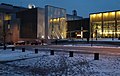 Kumpula Campus
 -
 Interior of the National Library
 -
 Kaisa House
 -
 Helsinki Natural History Museum
 -
 Old Student House
 -
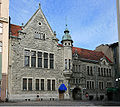 Nylands Nation House
 -
 Ostrobotnia House
 -
 Senate Square in Helsinki
.jpg)

.jpg)
.jpg)


.jpg)


