University of Sunderland: Difference between revisions
CSV import |
CSV import |
||
| Line 1: | Line 1: | ||
{{short description|Public university in Sunderland, England}} | |||
{{Use dmy dates|date=October 2023}} | |||
The | The '''University of Sunderland''' is a public research university located in [[Sunderland]], [[North East England]]. It was established in 1992, following the granting of university status to Sunderland Polytechnic. The university has campuses in Sunderland, [[London]], and [[Hong Kong]]. | ||
==History== | ==History== | ||
The | The origins of the University of Sunderland can be traced back to 1901, when Sunderland Technical College was established. In 1969, it became Sunderland Polytechnic, and in 1992, it was granted university status, becoming the University of Sunderland. | ||
==Campuses== | ==Campuses== | ||
The | The university has two main campuses in Sunderland: the City Campus and the St. Peter's Campus. | ||
== | ===City Campus=== | ||
The | The City Campus is located in the center of Sunderland and houses the main administrative and support services, library, and lecture halls. It is home to the faculties of Business, Law, and Tourism, as well as the Sciences Complex. | ||
===St. Peter's Campus=== | |||
[[File:St._Peter's_Campus.jpg|thumb|St. Peter's Campus]] | |||
St. Peter's Campus is situated on the north bank of the River Wear. It is home to the faculties of Arts and Creative Industries, and Education and Society. The campus is known for its modern architecture and riverside views. | |||
== | ==Academic Profile== | ||
The University of Sunderland offers a wide range of undergraduate and postgraduate programs. It is known for its strong emphasis on employability and industry links. The university has a reputation for excellence in areas such as pharmacy, engineering, and media. | |||
==Student Life== | ==Student Life== | ||
The university provides a vibrant student life with numerous clubs and societies. The Students' Union organizes events and activities throughout the year, including the annual Freshers' Week. | |||
==Alumni== | ==Notable Alumni== | ||
The | The university has produced many notable alumni, including [[Steve Cram]], a former middle-distance runner and sports commentator. | ||
== | ==Related Pages== | ||
* [[List of universities in the United Kingdom]] | |||
* [[Higher education in the United Kingdom]] | |||
[[Category: | ==Gallery== | ||
[[Category: | <gallery> | ||
File:University_of_Sunderland_logo.svg|University of Sunderland logo | |||
File:Former_Sunderland_Technical_College_(13920312969).jpg|Former Sunderland Technical College | |||
File:Steve_Cram_at_Freshers_Week,_2018.jpg|Steve Cram at Freshers' Week, 2018 | |||
File:Graduations_at_the_Stadium_of_Light.jpg|Graduations at the Stadium of Light | |||
File:City_Campus_Drone_Footage.jpg|City Campus drone footage | |||
File:Murray_Library,_City_Campus.jpg|Murray Library, City Campus | |||
File:Living_Lab_at_the_University_of_Sunderland,_City_Campus.jpg|Living Lab at the University of Sunderland, City Campus | |||
File:Clubs_and_Societies_Fayre.jpg|Clubs and Societies Fayre | |||
</gallery> | |||
[[Category:University of Sunderland]] | |||
[[Category:1992 establishments in England]] | |||
[[Category:Educational institutions established in 1992]] | |||
[[Category:Universities in England]] | |||
Revision as of 00:38, 10 February 2025
Public university in Sunderland, England
The University of Sunderland is a public research university located in Sunderland, North East England. It was established in 1992, following the granting of university status to Sunderland Polytechnic. The university has campuses in Sunderland, London, and Hong Kong.
History
The origins of the University of Sunderland can be traced back to 1901, when Sunderland Technical College was established. In 1969, it became Sunderland Polytechnic, and in 1992, it was granted university status, becoming the University of Sunderland.
Campuses
The university has two main campuses in Sunderland: the City Campus and the St. Peter's Campus.
City Campus
The City Campus is located in the center of Sunderland and houses the main administrative and support services, library, and lecture halls. It is home to the faculties of Business, Law, and Tourism, as well as the Sciences Complex.
St. Peter's Campus

St. Peter's Campus is situated on the north bank of the River Wear. It is home to the faculties of Arts and Creative Industries, and Education and Society. The campus is known for its modern architecture and riverside views.
Academic Profile
The University of Sunderland offers a wide range of undergraduate and postgraduate programs. It is known for its strong emphasis on employability and industry links. The university has a reputation for excellence in areas such as pharmacy, engineering, and media.
Student Life
The university provides a vibrant student life with numerous clubs and societies. The Students' Union organizes events and activities throughout the year, including the annual Freshers' Week.
Notable Alumni
The university has produced many notable alumni, including Steve Cram, a former middle-distance runner and sports commentator.
Related Pages
Gallery
-
University of Sunderland logo
-
 Former Sunderland Technical College
 -
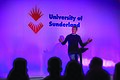 Steve Cram at Freshers' Week, 2018
 -
 Graduations at the Stadium of Light
 -
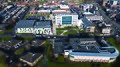 City Campus drone footage
 -
 Murray Library, City Campus
 -
 Living Lab at the University of Sunderland, City Campus
 -
 Clubs and Societies Fayre
.jpg)


