Tableting: Difference between revisions
CSV import |
CSV import |
||
| Line 27: | Line 27: | ||
{{medicine-stub}} | {{medicine-stub}} | ||
<gallery> | |||
File:Nestle-SweeTarts-Candies.jpg|Nestle SweeTarts Candies | |||
File:Tablet_press_animation.gif|Tablet Press Animation | |||
File:Dimsum_deep_fried_tofu_skin_roll.jpg|Dimsum Deep Fried Tofu Skin Roll | |||
</gallery> | |||
Latest revision as of 00:43, 18 February 2025
Tableting is the process of compacting material, typically pharmaceuticals or nutraceuticals, into tablets. The production of tablets is a complex, multi-step process that involves the preparation of the drug formulation, granulation or blending, compaction, and finally, coating (if required). Tableting is a critical step in the delivery of many medications and supplements, ensuring dose accuracy, stability, and patient compliance.
Overview[edit]
The tableting process begins with the creation of a uniform powder mixture that contains the active pharmaceutical ingredient (API) along with various excipients such as fillers, binders, lubricants, and disintegrants. This mixture is then subjected to either direct compression or granulation before being pressed into tablets.
Granulation[edit]
Granulation is a process used to improve the flow and compression characteristics of the powder mixture. It involves the agglomeration of fine particles into larger, more uniform granules. There are two main types of granulation: wet granulation and dry granulation. Wet granulation involves the addition of a liquid binder to form granules, which are then dried. Dry granulation, on the other hand, involves compacting the powder mixture under high pressure and then breaking the compacted mass into granules.
Compression[edit]
The granulated material is then fed into a tablet press, a machine that compresses the powder into tablets of uniform size, shape, and weight. The tablet press is equipped with dies and punches that define the dimensions of the tablet. The compression force must be carefully controlled to ensure that the tablets are neither too hard (which could affect disintegration and dissolution) nor too soft (which could affect the tablet's durability and appearance).
Coating[edit]
After compression, tablets may undergo a coating process, which can serve several purposes: to protect the tablet from the environment, to mask the taste of the API, to provide a controlled release of the drug, or to make the tablet easier to swallow. The most common types of coatings are film coatings and sugar coatings.
Quality Control[edit]
Quality control (QC) in tableting is paramount to ensure that the tablets produced meet the required specifications. QC tests include measurements of tablet weight, hardness, friability (the tendency of the tablet to crumble), disintegration time, and dissolution rate.
Regulatory Aspects[edit]
The tableting process is subject to stringent regulations to ensure the safety, efficacy, and quality of pharmaceutical products. Regulatory bodies such as the Food and Drug Administration (FDA) in the United States and the European Medicines Agency (EMA) in Europe set guidelines for good manufacturing practices (GMP) in the production of tablets.
Challenges and Innovations[edit]
The tableting process faces several challenges, including the handling of very potent APIs, the need for increased efficiency and productivity, and the demand for more complex tablet formulations that can provide targeted drug delivery or controlled release. Innovations in tableting technology, such as the development of multi-layer tablets and the use of more efficient and versatile tablet presses, are helping to address these challenges.

-
 Nestle SweeTarts Candies
 -
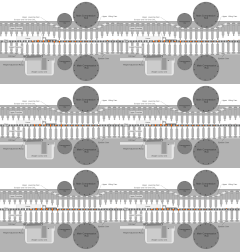 Tablet Press Animation
 -
 Dimsum Deep Fried Tofu Skin Roll


