Red giant: Difference between revisions
CSV import |
CSV import |
||
| Line 17: | Line 17: | ||
[[Category:Stars]] | [[Category:Stars]] | ||
{{astronomy-stub}} | {{astronomy-stub}} | ||
== Red giant gallery == | |||
<gallery> | |||
File:Red giant simulation 4 (cropped).jpg|Red giant simulation 4 | |||
File:Structure of Stars (artist’s impression).jpg|Structure of Stars (artist’s impression) | |||
File:The life cycle of a Sun-like star (annotated).jpg|The life cycle of a Sun-like star (annotated) | |||
File:Seeing into the Heart of Mira A and its Partner.jpg|Seeing into the Heart of Mira A and its Partner | |||
</gallery> | |||
Latest revision as of 06:08, 3 March 2025

A Red Giant is a phase in the life cycle of a star where it expands and cools after having exhausted the hydrogen fuel in its core. This phase marks the transition of a star from the main sequence to the final stages of its stellar evolution, which can include becoming a white dwarf, a neutron star, or, in the case of the most massive stars, a black hole.
Characteristics[edit]
Red giants are characterized by their large size, cool surface temperatures, and reddish hue. These stars have exhausted the hydrogen in their cores and have begun to fuse helium into heavier elements such as carbon and oxygen. The outer layers of a red giant are expansive and can extend up to several hundred times the star's original size when it was on the main sequence.
Formation[edit]
The formation of a red giant begins when a star exhausts the hydrogen fuel in its core. Without the outward pressure generated by hydrogen fusion, the core begins to contract under gravity. This increases the temperature and pressure in the shell surrounding the core, causing hydrogen in this shell to fuse at an accelerated rate. The increased energy output from this shell fusion causes the star's outer layers to expand and cool, giving the star its characteristic red color and large size.
Evolution[edit]
The evolution of a red giant is determined by its mass. Lower-mass stars, like the Sun, will eventually shed their outer layers to form a planetary nebula, leaving behind a white dwarf. More massive stars may undergo further stages of nuclear fusion, fusing heavier elements in their cores or in shells around the core. These stars can end their lives in spectacular supernova explosions, leaving behind neutron stars or black holes.
Significance[edit]
Red giants are significant for several reasons. They are a crucial stage in the stellar life cycle, marking the transition from main sequence to the final stages of stellar evolution. The materials that red giants eject into space, including heavy elements and dust, contribute to the interstellar medium and play a vital role in the formation of new stars and planets. Additionally, studying red giants helps astronomers understand the future of our own Sun and the evolution of stars across the universe.
See also[edit]

Red giant gallery[edit]
-
 Red giant simulation 4
 -
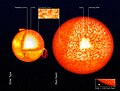 Structure of Stars (artist’s impression)
 -
 The life cycle of a Sun-like star (annotated)
 -
 Seeing into the Heart of Mira A and its Partner
.jpg)
.jpg)
.jpg)

