Multimeter: Difference between revisions
CSV import |
CSV import Tags: mobile edit mobile web edit |
||
| Line 38: | Line 38: | ||
[[Category:Electronic test equipment]] | [[Category:Electronic test equipment]] | ||
{{electronics-stub}} | {{electronics-stub}} | ||
== Multimeter == | |||
<gallery> | |||
File:YX360TRF(Sanwa).JPG|YX360TRF (Sanwa) | |||
File:Digital_Multimeter_Aka.jpg|Digital Multimeter | |||
File:1920s_multimeter_3738-6b.jpg|1920s Multimeter | |||
File:AVO_Model_8_Mk7_P4_by_Megger.jpg|AVO Model 8 Mk7 | |||
File:Pifco_Universal-Prüfer.jpg|Pifco Universal-Prüfer | |||
File:Clampmeter_Fluke_337.jpg|Clampmeter Fluke 337 | |||
File:Multimeter-4254e.jpg|Multimeter | |||
File:Benchtop_multimeter.jpg|Benchtop Multimeter | |||
</gallery> | |||
Latest revision as of 00:50, 27 February 2025

A multimeter or a multitester, also known as a VOM (Volt-Ohm-Milliammeter), is an electronic measuring instrument that combines several measurement functions in one unit. A typical multimeter can measure voltage, current, and resistance. Advanced models may also have the capability to measure capacitance, conductance, frequency, temperature, and inductance. Multimeters are used in all areas of electronics to diagnose and troubleshoot circuits, as well as in the installation and repair of electrical equipment.
Functions[edit]
The primary functions of a multimeter are to measure voltage (volts), current (amps), and resistance (ohms).
- Voltage Measurement: This function measures the potential difference between two points in an electrical circuit. Multimeters can measure both alternating current (AC) and direct current (DC) voltages.
- Current Measurement: This function measures the flow of electric charge through a conductor. Like voltage, current can be AC or DC.
- Resistance Measurement: This measures how much an object opposes the flow of electric current through it. This function is crucial for identifying broken circuits and ensuring components are within their operational tolerance.
Types of Multimeters[edit]
Multimeters come in two primary types: analog and digital.
- Analog Multimeters: These use a moving pointer to display readings on a scale. They are less common today but are valued for their ability to show changes in readings over time.
- Digital Multimeters (DMMs): These display readings in numeric form, making them easier to read than analog multimeters. DMMs often come with additional features such as auto-ranging, which automatically selects the correct range for the measurement being taken.
Features[edit]
Modern multimeters may include features such as:
- Auto-ranging
- Data hold
- Min/Max recording
- Backlit display
- True RMS sensing for accurate AC measurements
Safety[edit]
When using a multimeter, safety is paramount. Users should always:
- Check the multimeter's rating and ensure it is suitable for the electrical environment in which it will be used.
- Inspect the multimeter and leads for any damage before use.
- Never exceed the operational limits of the multimeter.
Applications[edit]
Multimeters are indispensable tools in many fields, including electronics, automotive repair, and electrical engineering. They are used for:
- Troubleshooting and repairing circuits
- Installing and maintaining electrical equipment
- Designing electronic systems
- Educational purposes in physics and engineering classes
See Also[edit]
References[edit]
 | This electronics-related article is a stub. You can help WikiMD by expanding the page. |
Multimeter[edit]
-
 YX360TRF (Sanwa)
 -
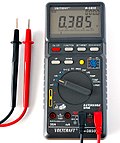 Digital Multimeter
 -
 1920s Multimeter
 -
 AVO Model 8 Mk7
 -
 Pifco Universal-Prüfer
 -
 Clampmeter Fluke 337
 -
 Multimeter
 -
 Benchtop Multimeter
.JPG)


