Mentha cervina: Difference between revisions
CSV import Tags: mobile edit mobile web edit |
CSV import |
||
| Line 19: | Line 19: | ||
[[Category:Herbs]] | [[Category:Herbs]] | ||
{{plant-stub}} | {{plant-stub}} | ||
== Mentha cervina gallery == | |||
<gallery> | |||
File:Mentha cervina flower.jpg|Mentha cervina flower | |||
File:Mentha cervina leaves in detail.jpg|Mentha cervina leaves in detail | |||
File:Mentha cervina.jpg|Mentha cervina | |||
</gallery> | |||
Latest revision as of 05:30, 3 March 2025

Mentha cervina, commonly known as Hart's pennyroyal, is a species of flowering plant in the Lamiaceae family, which is native to parts of Europe and North Africa. This perennial herb is characterized by its aromatic leaves and is often found in moist habitats, including stream sides and wet meadows. The genus Mentha encompasses a wide range of species, many of which are valued for their distinctive fragrances and are used in culinary, medicinal, and ornamental applications.
Description[edit]
Mentha cervina is a perennial herb that typically grows to a height of 10-50 cm. Its stems are square in cross-section, a common trait among members of the Lamiaceae family. The leaves of Mentha cervina are lanceolate to ovate, smooth-edged, and emit a strong, pleasant aroma when crushed. The plant produces small, lilac or purple flowers in whorls around the stem, blooming from late spring to early autumn.
Habitat and Distribution[edit]
Mentha cervina is native to the western Mediterranean region, including parts of Portugal, Spain, and North Africa. It thrives in wet environments, such as the banks of streams, rivers, and in damp meadows. The plant's preference for moist habitats has also enabled it to adapt to garden settings, where it is sometimes cultivated as an ornamental or culinary herb.
Cultivation and Uses[edit]
In cultivation, Mentha cervina prefers full sun to partial shade and consistently moist soil. It is valued for its aromatic leaves, which can be used fresh or dried in a variety of culinary dishes. The herb is also occasionally used in traditional medicine, although scientific evidence supporting its efficacy is limited. Due to its vigorous growth habit, Mentha cervina can become invasive in some settings, and care should be taken to manage its spread in garden environments.
Conservation[edit]
While Mentha cervina is not currently listed as endangered, its habitats are susceptible to environmental changes and habitat destruction. Conservation efforts are important to ensure the survival of this species and its natural habitat, particularly in areas where industrial or agricultural development threatens wetland ecosystems.
See Also[edit]

Mentha cervina gallery[edit]
-
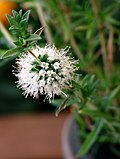 Mentha cervina flower
 -
 Mentha cervina leaves in detail
 -
 Mentha cervina


