Ferdinand Ritter von Hebra: Difference between revisions
CSV import Tags: mobile edit mobile web edit |
CSV import |
||
| Line 30: | Line 30: | ||
{{Medicine-stub}} | {{Medicine-stub}} | ||
<gallery> | |||
File:Ferdinand_von_Hebra_(1816-1880)_young.jpg|Ferdinand von Hebra as a young man | |||
File:Ferdinand_von_Hebra_(1816-1880).jpg|Ferdinand von Hebra | |||
File:Das_Wiener_Professoren_Kollegium_1853.jpg|Das Wiener Professoren Kollegium 1853 | |||
File:Lupus_erythematosus,_Atlas_der_Hautkrankheiten.jpg|Lupus erythematosus, Atlas der Hautkrankheiten | |||
</gallery> | |||
Latest revision as of 05:05, 18 February 2025
Ferdinand Ritter von Hebra (1816–1880) was an Austrian physician and dermatologist who is considered one of the founding fathers of dermatology. He was born in Brno, Moravia (now in the Czech Republic) and later moved to Vienna, where he spent the majority of his professional life. Hebra was instrumental in establishing dermatology as a distinct medical discipline and was the founder of the first dermatology clinic in the world at the Vienna General Hospital.
Early Life and Education[edit]
Ferdinand von Hebra was born on September 7, 1816, in Brno. He pursued his medical education at the University of Vienna, where he was greatly influenced by the teachings of Johann Lukas Schönlein, a pioneer in the field of dermatology. After completing his studies, Hebra focused his research and practice on skin diseases, recognizing the need for a specialized field of study.
Career and Contributions[edit]
In 1845, Hebra was appointed as the head of the dermatology department at the Vienna General Hospital, marking the establishment of the world's first dermatology clinic. His approach to treating skin diseases was revolutionary at the time, emphasizing the importance of clinical observation and the classification of diseases based on their symptoms and appearances.
Hebra is best known for his work on scabies, a disease caused by the mite Sarcoptes scabiei. He was the first to identify the mite as the cause of the disease, which was a significant breakthrough in medical science. His method of treatment for scabies, involving sulfur ointments, became the standard for many years.
Another significant contribution of Hebra was his work on eczema, a common skin condition. He was among the first to describe the clinical characteristics of eczema and differentiate it from other skin diseases. Hebra also made notable contributions to the understanding and treatment of other skin conditions, such as psoriasis, leprosy, and dermatitis herpetiformis.
Legacy[edit]
Ferdinand von Hebra's legacy in dermatology is monumental. He laid the groundwork for the modern study of skin diseases and is credited with transforming dermatology into a scientifically based medical discipline. The Hebra's Atlas of Skin Diseases, published in 1856, was one of the first comprehensive atlases of dermatology and is considered a classic in the field.
Hebra was also a mentor to many future leaders in dermatology, including Moriz Kaposi, who succeeded him at the Vienna General Hospital. His teachings and publications have had a lasting impact on the field of dermatology, making him a pivotal figure in its history.
Death and Honors[edit]
Ferdinand Ritter von Hebra died on August 5, 1880, in Vienna. In recognition of his contributions to medicine, he was knighted, receiving the title "Ritter". His work continues to be celebrated in the medical community, and he is remembered as a pioneer who significantly advanced the understanding and treatment of skin diseases.
See Also[edit]

-
 Ferdinand von Hebra as a young man
 -
 Ferdinand von Hebra
 -
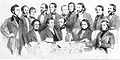 Das Wiener Professoren Kollegium 1853
 -
 Lupus erythematosus, Atlas der Hautkrankheiten
_young.jpg)
.jpg)


