Shape-memory polymer: Difference between revisions
CSV import Tags: mobile edit mobile web edit |
CSV import |
||
| Line 34: | Line 34: | ||
{{Material-science-stub}} | {{Material-science-stub}} | ||
== Shape-memory polymer gallery == | |||
<gallery> | |||
File:wiki thermomechanical test.jpg|Thermomechanical test | |||
File:SMProcess.jpg|Shape-memory process | |||
File:wiki norbornene.jpg|Norbornene | |||
File:lightinduced.jpg|Light-induced shape-memory effect | |||
</gallery> | |||
Latest revision as of 05:22, 3 March 2025
Shape-memory polymers (SMPs) are a class of polymers that have the ability to return from a deformed state (temporary shape) to their original (permanent) shape induced by an external stimulus (trigger), such as temperature change. SMPs are finding applications in various fields such as biomedical engineering, aerospace engineering, and textile engineering due to their unique properties and functionalities.
Overview[edit]
Shape-memory polymers are characterized by their ability to undergo a physical change when exposed to a specific external stimulus. Unlike shape-memory alloys, which are well-known for their use in medical stents and eyeglass frames, SMPs offer advantages such as easy processing, lower cost, and higher capacity for deformation. The shape-memory effect in polymers is primarily due to the presence of two distinct phases: a fixed phase that determines the permanent shape and a reversible phase that allows the material to be deformed and fixed into a temporary shape.
Mechanism[edit]
The shape-memory effect in SMPs involves two main processes: programming and recovery. During programming, the polymer is heated above its transition temperature (T_trans), which is either the glass transition temperature (T_g) or the melting temperature (T_m), allowing it to be easily deformed. The material is then cooled under constraint to below T_trans, fixing the temporary shape. Upon reheating above T_trans, the stored mechanical energy is released, and the polymer returns to its original shape.
Types of Stimuli[edit]
While temperature is the most common stimulus for SMPs, other stimuli such as light (photo-induced shape memory), electric field (electroactive polymers), magnetic field (magnetoactive polymers), and solution (chemo-responsive polymers) have also been explored. This versatility opens up a wide range of applications for SMPs.
Applications[edit]
Biomedical[edit]
In the biomedical field, SMPs are used in drug delivery systems, sutures, stents, and tissue engineering. Their ability to change shape at body temperature or in response to other stimuli makes them ideal for minimally invasive surgical procedures and targeted therapies.
Aerospace[edit]
In aerospace, SMPs contribute to the development of morphing wings and self-healing structures. Their light weight and adaptive characteristics offer significant advantages in terms of fuel efficiency and maintenance.
Textile[edit]
In textile engineering, SMPs are used to create smart fabrics that can adapt to environmental changes or provide comfort and protection to the wearer by changing their porosity or rigidity.
Challenges and Future Directions[edit]
Despite their potential, the widespread adoption of SMPs faces challenges such as the need for improved material properties (e.g., strength, durability) and better understanding of their long-term behavior. Ongoing research is focused on developing new SMPs with enhanced functionalities and on expanding their applications through innovative engineering solutions.
See Also[edit]
This material science related article is a stub. You can help WikiMD by expanding it.
Shape-memory polymer gallery[edit]
-
Thermomechanical test
-
 Shape-memory process
 -
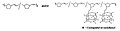 Norbornene
 -
 Light-induced shape-memory effect


