Human evolution: Difference between revisions
CSV import |
CSV import |
||
| Line 33: | Line 33: | ||
{{Anthropology-stub}} | {{Anthropology-stub}} | ||
{{Prehistory-stub}} | {{Prehistory-stub}} | ||
<gallery> | |||
File:Ape skeletons.png|Ape skeletons | |||
File:Notharctus tenebrosus AMNH.jpg|Notharctus tenebrosus AMNH | |||
File:Proconsul skeleton reconstitution (University of Zurich).JPG|Proconsul skeleton reconstitution (University of Zurich) | |||
File:016 Alpha male chimpanzee walking at Kibale forest National Park Photo by Giles Laurent.jpg|Alpha male chimpanzee walking at Kibale forest National Park | |||
File:Bienvenida al Museo de Lucy.jpg|Bienvenida al Museo de Lucy | |||
File:Chimp's Nest.jpg|Chimp's Nest | |||
File:Homo-Stammbaum, Version Stringer-en.svg|Homo-Stammbaum, Version Stringer | |||
File:Homo-erectus Turkana-Boy (Ausschnitt) Fundort Nariokotome, Kenia, Rekonstruktion im Neanderthal Museum.jpg|Homo erectus Turkana Boy (Ausschnitt) Fundort Nariokotome, Kenia, Rekonstruktion im Neanderthal Museum | |||
File:Homo sapiens neanderthalensis-Mr. N.jpg|Homo sapiens neanderthalensis Mr. N | |||
File:Homo floresiensis v 2-0.jpg|Homo floresiensis v 2.0 | |||
</gallery> | |||
Latest revision as of 06:09, 3 March 2025
Human evolution is the lengthy process of change by which people originated from apelike ancestors. Scientific evidence shows that the physical and behavioral traits shared by all people originated from apelike ancestors and evolved over a period of approximately six million years.
One of the earliest defining human traits, bipedalism—the ability to walk on two legs—evolved over 4 million years ago. Other important human characteristics, such as a large and complex brain, the ability to make and use tools, and the capacity for language, developed more recently. Many advanced traits—including complex symbolic expression, art, and elaborate cultural diversity—emerged mainly during the past 100,000 years.
Prehistoric Times[edit]
Human evolution is characterized by a number of morphological, developmental, physiological, and behavioral changes that have taken place since the split between the last common ancestor of humans and chimpanzees. The most notable of these changes are:
- The development of bipedalism.
- Increased brain size and complexity.
- Decrease in the size of the teeth and jaws.
- The development of language and symbolic culture.
The Genus Homo[edit]
The genus Homo first appeared about 2.4 to 2.8 million years ago. Homo habilis, identified as the first species to make tools, was followed by Homo erectus, which spread throughout Africa, Asia, and Europe. Homo neanderthalensis and Homo sapiens (modern humans) coexisted and interbred with each other and with other species outside Africa, such as Denisovans.
Modern Humans[edit]
Modern humans (Homo sapiens) are believed to have originated in Africa about 300,000 years ago. Evidence from molecular biology, archaeology, and anthropology supports the Out of Africa theory, which posits that modern humans evolved in Africa and then dispersed to other parts of the world. This migration began roughly 60,000 to 70,000 years ago, leading to the colonization of the entire globe by Homo sapiens.
Cultural Evolution[edit]
Cultural evolution has played a significant role in human evolution, especially as humans began to develop complex tools, art, and language. The ability to create and use tools, to communicate and share knowledge through language, and to form complex social structures has allowed humans to adapt to a wide range of environments.
Challenges and Future Directions[edit]
The study of human evolution is continually evolving, with new discoveries and technologies contributing to our understanding of our origins. The field faces challenges, such as the interpretation of fossil evidence and the integration of genetic data with archaeological and anthropological findings.
See Also[edit]

This article is a prehistory-related stub. You can help WikiMD by expanding it!
-
 Ape skeletons
 -
 Notharctus tenebrosus AMNH
 -
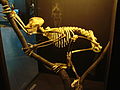 Proconsul skeleton reconstitution (University of Zurich)
 -
 Alpha male chimpanzee walking at Kibale forest National Park
 -
 Bienvenida al Museo de Lucy
 -
 Chimp's Nest
 -
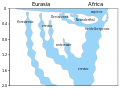 Homo-Stammbaum, Version Stringer
 -
 Homo erectus Turkana Boy (Ausschnitt) Fundort Nariokotome, Kenia, Rekonstruktion im Neanderthal Museum
 -
 Homo sapiens neanderthalensis Mr. N
 -
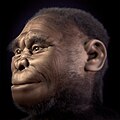 Homo floresiensis v 2.0


.JPG)


_Fundort_Nariokotome,_Kenia,_Rekonstruktion_im_Neanderthal_Museum.jpg)


