Niclosamide: Difference between revisions
CSV import Tags: mobile edit mobile web edit |
CSV import |
||
| Line 26: | Line 26: | ||
[[Category:Chemical compounds]] | [[Category:Chemical compounds]] | ||
{{medicine-stub}} | {{medicine-stub}} | ||
<gallery> | |||
File:Niclosamide.svg|Chemical structure of Niclosamide | |||
File:Niclosamide-from-xtal-Mercury-3D-sf.png|3D model of Niclosamide from crystal structure | |||
File:Wienermobile_at_Super_One.jpg|Wienermobile at Super One | |||
</gallery> | |||
Latest revision as of 00:44, 18 February 2025
Niclosamide is an anthelmintic medication used primarily for the treatment of tapeworm infections. It is effective against a broad range of tapeworms including Taenia saginata (beef tapeworm), Taenia solium (pork tapeworm), and some species of Diphyllobothrium and Hymenolepis. Niclosamide works by inhibiting the oxidative phosphorylation in the mitochondria of the tapeworm, leading to the immobilization and eventual death of the parasite.
Medical Uses[edit]
Niclosamide is indicated for the treatment of intestinal tapeworm infections. It is administered orally, usually in a single dose. The drug is not absorbed significantly from the gastrointestinal tract, which ensures its concentration in the intestine where the tapeworms reside. For some types of infections, a second dose may be required a week after the first to ensure complete eradication of the parasite.
Mechanism of Action[edit]
The primary mechanism by which niclosamide exerts its anthelmintic effect is by uncoupling oxidative phosphorylation in the mitochondria of the tapeworm. This action disrupts the production of ATP, which is essential for the survival and reproduction of the parasite. Without ATP, the tapeworm loses its ability to maintain its metabolism and dies.
Side Effects[edit]
Niclosamide is generally well tolerated, but some individuals may experience side effects. The most common adverse effects include abdominal pain, nausea, vomiting, and diarrhea. These symptoms are usually mild and transient. Rarely, more severe reactions can occur, including allergic reactions characterized by rash, itching, and difficulty breathing.
Precautions[edit]
Before taking niclosamide, it is important to inform the healthcare provider about any existing allergies to medications. Additionally, the safety and efficacy of niclosamide in pregnant or breastfeeding women have not been established. Therefore, it should be used in these populations only if clearly needed and if the benefits outweigh the risks.
Pharmacokinetics[edit]
Niclosamide is poorly absorbed from the gastrointestinal tract, which is beneficial for its action against intestinal parasites but also means that it is not effective against systemic infections. The drug is metabolized in the liver and excreted in the feces.
History[edit]
Niclosamide was first introduced in the 1950s for the treatment of tapeworm infections. Since then, it has been included in the World Health Organization's List of Essential Medicines, indicating its importance in a basic health system.
Recent Research[edit]
Recent studies have explored the potential use of niclosamide in treating other conditions beyond tapeworm infections, including some forms of cancer and viral infections. Its ability to inhibit cellular pathways involved in inflammation and proliferation has made it a candidate for repurposing in various therapeutic areas.

-
 Chemical structure of Niclosamide
 -
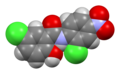 3D model of Niclosamide from crystal structure
 -
 Wienermobile at Super One


