Size-exclusion chromatography: Difference between revisions
CSV import Tags: mobile edit mobile web edit |
CSV import |
||
| Line 39: | Line 39: | ||
{{Chemistry-stub}} | {{Chemistry-stub}} | ||
<gallery> | |||
File:Akta_Pure_SEC_systems.jpg|ÄKTA Pure size-exclusion chromatography systems | |||
File:Size_Exclusion_Chromatography_Apparatus.jpg|Size-exclusion chromatography apparatus | |||
File:Superdex_200HR_gel_filtration_column.jpg|Superdex 200HR gel filtration column | |||
File:SizeExChrom.png|Size-exclusion chromatography | |||
File:Size_exclusion_standardisation.png|Size-exclusion chromatography standardisation | |||
File:Chrom_SephG-50.tif|Size-exclusion chromatography | |||
</gallery> | |||
Latest revision as of 10:55, 18 February 2025
Size-exclusion chromatography (SEC), also known as gel filtration chromatography, is a chromatographic method in which molecules in solution are separated by their size, and in some cases molecular weight, through a column filled with a porous stationary phase. SEC is widely used in both analytical and preparative applications, ranging from the purification of large biomolecules such as proteins and nucleic acids to the analysis of small molecules in complex mixtures.
Principle[edit]
The principle of size-exclusion chromatography relies on the differential partitioning of components in a sample between a mobile phase (solvent) and a stationary phase (a column packed with porous particles). Molecules larger than the pores of the stationary phase cannot enter the pores and are eluted from the column first. Smaller molecules, however, can enter the pores and are retained for longer periods within the column, leading to their later elution. Thus, separation is achieved based on the size of the molecules, with larger molecules eluting before smaller ones.
Components[edit]
Stationary Phase[edit]
The stationary phase in SEC consists of a column packed with porous beads made from materials such as agarose, dextran, or polyacrylamide. The choice of material and the pore size of the beads are critical factors that determine the separation range and efficiency of the chromatography.
Mobile Phase[edit]
The mobile phase is the solvent that carries the sample through the column. It is chosen based on the compatibility with the sample and the stationary phase. Common solvents include water, buffer solutions, and organic solvents for non-aqueous applications.
Applications[edit]
Size-exclusion chromatography is utilized in various fields for different purposes:
- In biochemistry, SEC is used for the purification and analysis of proteins, nucleic acids, and other biomolecules.
- In polymer science, it helps in determining the molecular weight distribution of polymers.
- SEC is also employed in the food industry for the analysis of polysaccharides and other macromolecules.
Advantages and Limitations[edit]
Advantages[edit]
- SEC is a gentle separation technique, making it suitable for the purification of sensitive biological molecules.
- It allows for the separation of molecules based on size, independent of their ionic strength or hydrophobicity.
Limitations[edit]
- SEC does not provide information about the molecular structure or composition.
- The resolution of SEC is generally lower than that of other chromatographic techniques, such as high-performance liquid chromatography (HPLC).
See Also[edit]
References[edit]
<references/>

-
 ÄKTA Pure size-exclusion chromatography systems
 -
 Size-exclusion chromatography apparatus
 -
 Superdex 200HR gel filtration column
 -
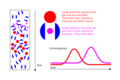 Size-exclusion chromatography
 -
 Size-exclusion chromatography standardisation
 -
 Size-exclusion chromatography


