San people: Difference between revisions
CSV import |
CSV import |
||
| Line 38: | Line 38: | ||
{{Ethnic group}} | {{Ethnic group}} | ||
{{African people stub}} | {{African people stub}} | ||
<gallery> | |||
File:Namibian_Bushmen_Girls.JPG|Namibian Bushmen Girls | |||
File:KhoisanLanguagesModernDistribution.png|Khoisan Languages Modern Distribution | |||
File:Portrait_of_a_bushman._Alfred_Duggan-Cronin._South_Africa,_early_20th_century._The_Wellcome_Collection,_London.jpg|Portrait of a Bushman, Alfred Duggan-Cronin, South Africa, early 20th century | |||
File:Bushmen_Hottentots_armed_for_an_expedition.png|Bushmen Hottentots armed for an expedition | |||
File:Botswana_063.jpg|Botswana | |||
File:BushmenSan.jpg|Bushmen San | |||
File:San_wh03.jpg|San | |||
File:San_tribesman.jpg|San tribesman | |||
</gallery> | |||
Latest revision as of 00:58, 27 February 2025
San people, also known as the Bushmen, are indigenous hunter-gatherer groups of Southern Africa. They have a rich cultural heritage and are known for their deep connection with their environment. The San people have historically been spread across various countries in Southern Africa, including Botswana, Namibia, Angola, South Africa, Zambia, and Zimbabwe. Their languages are part of the Khoisan language group, characterized by distinctive click sounds.
History[edit]
The history of the San people is deeply intertwined with the history of Southern Africa. Archaeological evidence suggests that they have lived in the region for tens of thousands of years. Rock art, which is believed to have been created by San ancestors, can be found in various parts of Southern Africa and is considered one of the oldest art forms in the world.
Culture[edit]
The culture of the San people is rich and diverse. Traditionally, they have lived in small family groups, leading a nomadic lifestyle that is closely tied to their environment. They are renowned for their knowledge of the natural world, including an intimate understanding of local flora and fauna, which they utilize for both medicinal purposes and sustenance.
Language[edit]
The languages spoken by the San people are part of the Khoisan language family, known for their distinctive click consonants. These languages are among the most ancient in the world and are a crucial aspect of San cultural identity.
Art[edit]
San art, particularly rock paintings and engravings, is a significant part of their cultural heritage. This art often depicts various aspects of their daily life, spiritual beliefs, and the animals they hunt. The Tsodilo Hills in Botswana, for example, is a UNESCO World Heritage Site famous for its rock art.
Challenges[edit]
The San people face numerous challenges today, including land rights issues, access to education, and preservation of their cultural and linguistic heritage. Many San communities have been displaced from their ancestral lands due to the expansion of national parks and the discovery of valuable natural resources. This displacement poses a significant threat to their traditional way of life.
Rights and Advocacy[edit]
There have been various efforts to protect the rights and way of life of the San people. Organizations such as the Working Group of Indigenous Minorities in Southern Africa (WIMSA) and the South African San Institute work towards advocating for the rights of the San people, including land rights, cultural preservation, and education.
See Also[edit]
References[edit]
<references/>
-
 Namibian Bushmen Girls
 -
 Khoisan Languages Modern Distribution
 -
 Portrait of a Bushman, Alfred Duggan-Cronin, South Africa, early 20th century
 -
 Bushmen Hottentots armed for an expedition
 -
 Botswana
 -
 Bushmen San
 -
 San
San -
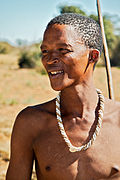 San tribesman


