Wave–particle duality: Difference between revisions
CSV import Tags: mobile edit mobile web edit |
CSV import |
||
| Line 25: | Line 25: | ||
{{Quantum mechanics}} | {{Quantum mechanics}} | ||
{{Physics-stub}} | {{Physics-stub}} | ||
== Hajj gallery == | |||
<gallery> | |||
File:The Hajj kicks into full gear - Flickr - Al Jazeera English (8).jpg|The Hajj kicks into full gear | |||
File:Haji pilgrimage mina tent city.jpg|Haji pilgrimage mina tent city | |||
File:Hajj certificate, dated 602 AH or 1205 CE, Ayyubid period, Turkish and Islamic Arts Museum.jpg|Hajj certificate, dated 602 AH or 1205 CE, Ayyubid period, Turkish and Islamic Arts Museum | |||
File:Masjid al-Haram 1.jpg|Masjid al-Haram | |||
File:Hajj locations and rites.png|Hajj locations and rites | |||
File:Tavaf.jpg|Tavaf | |||
File:Sa'yee To Go.jpg|Sa'yee To Go | |||
File:Sa'yee For older.jpg|Sa'yee For older | |||
File:Sa'yee To return.jpg|Sa'yee To return | |||
</gallery> | |||
Latest revision as of 17:48, 3 March 2025
Wave–particle duality is a fundamental concept in quantum mechanics that posits that every particle or quantum entity exhibits both wave and particle properties. This duality is a cornerstone of the quantum theory and challenges the classical intuition that physical entities are either particles or waves, but not both. The concept was first introduced to explain the behavior of light and electrons, with experiments showing that these entities can exhibit wave-like behavior in some contexts, such as interference and diffraction, and particle-like behavior in others, such as photoelectric effect and Compton scattering.
Historical Background[edit]
The wave–particle duality concept has its roots in the early 20th century when physicists were grappling with the nature of light and matter. The debate began with the classical corpuscular theory of light, proposed by Isaac Newton, which suggested that light consists of particles. In contrast, the wave theory of light, championed by Christiaan Huygens, argued that light behaves as a wave. The discovery of the photoelectric effect by Albert Einstein in 1905, for which he won the Nobel Prize in Physics, provided strong evidence for the particle nature of light, as it could be explained only by quantizing light into discrete packets of energy, later called photons.
Quantum Mechanics and Duality[edit]
The formalism of quantum mechanics, developed in the 1920s by physicists such as Werner Heisenberg, Erwin Schrödinger, and Max Born, provided a mathematical framework that could accommodate the dual nature of particles and waves. The Heisenberg uncertainty principle and the concept of wave functions are central to understanding how quantum entities can exhibit both particle and wave characteristics.
Key Experiments[edit]
Several key experiments highlight the wave–particle duality of quantum entities:
- Double-slit experiment: Demonstrates the interference pattern that results when light (or matter, such as electrons) passes through two slits, suggesting wave-like behavior. However, when observed or measured, the entities exhibit particle-like behavior, impacting one of the two detectors placed behind the slits.
- Photoelectric effect: Shows that light can eject electrons from a metal surface if the light's frequency is above a certain threshold, indicating that light behaves as a stream of particles (photons).
- Compton scattering: Involves the scattering of X-rays by electrons, providing evidence of the particle nature of light.
Implications[edit]
The wave–particle duality has profound implications for our understanding of the fundamental nature of reality. It challenges the classical notion of determinism and introduces the concept of quantum superposition, where a quantum entity can exist in multiple states simultaneously until it is observed or measured.
Conclusion[edit]
Wave–particle duality is a key principle of quantum mechanics that has reshaped our understanding of the microscopic world. It underscores the limitations of classical physics in describing the behavior of quantum entities and highlights the complex and counterintuitive nature of the quantum realm.
| Quantum mechanics |
|---|
|
[[File:|200px|center|alt=]]
|

Hajj gallery[edit]
-
 The Hajj kicks into full gear
 -
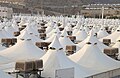 Haji pilgrimage mina tent city
 -
 Hajj certificate, dated 602 AH or 1205 CE, Ayyubid period, Turkish and Islamic Arts Museum
 -
 Masjid al-Haram
 -
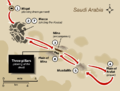 Hajj locations and rites
 -
 Tavaf
Tavaf -
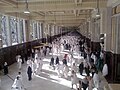 Sa'yee To Go
 -
 Sa'yee For older
 -
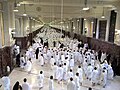 Sa'yee To return
.jpg)


