Curtius rearrangement: Difference between revisions
CSV import Tags: mobile edit mobile web edit |
CSV import |
||
| Line 21: | Line 21: | ||
[[Category:Rearrangement reactions]] | [[Category:Rearrangement reactions]] | ||
{{Chemistry-stub}} | {{Chemistry-stub}} | ||
== Curtius rearrangement gallery == | |||
<gallery> | |||
File:Curtius rearrangement rxn.png|Curtius rearrangement reaction | |||
File:DPPA-3D-balls.png|DPPA 3D balls | |||
File:Acyl azide formation.png|Acyl azide formation | |||
File:Curtius rearrangement mech concerted.png|Curtius rearrangement mechanism concerted | |||
File:Curtius rearrangement photochemical mech.png|Curtius rearrangement photochemical mechanism | |||
File:Curtius rearrangement nitrene insertion.png|Curtius rearrangement nitrene insertion | |||
File:Darapsky amino acid synthesis.png|Darapsky amino acid synthesis | |||
File:Harger reaction scheme.png|Harger reaction scheme | |||
File:Woodward triquinacene curtius rearr.png|Woodward triquinacene Curtius rearrangement | |||
File:Ishikawa oseltaimvir curtius rearr.png|Ishikawa oseltamivir Curtius rearrangement | |||
</gallery> | |||
Latest revision as of 05:05, 3 March 2025
Curtius Rearrangement is a chemical reaction involving the thermal decomposition of an azide to generate an isocyanate, which can further react to form amines, amides, or ureas. This reaction is named after the German chemist Theodor Curtius, who first reported it in 1885. The Curtius Rearrangement is an important reaction in organic chemistry for the synthesis of a wide range of nitrogen-containing compounds.
Mechanism[edit]
The Curtius Rearrangement proceeds through the thermal decomposition of an azide (R-N3) to form an isocyanate (R-NCO). This step involves the loss of nitrogen gas (N2), making the reaction highly exothermic. The generated isocyanate can then undergo various nucleophilic additions depending on the reaction conditions and the nucleophiles present. For example, the reaction with water leads to the formation of a primary amine and carbon dioxide. Alternatively, reaction with an alcohol or amine results in the formation of an urethane or urea, respectively.
Applications[edit]
The versatility of the Curtius Rearrangement has made it a valuable tool in the synthesis of a variety of nitrogen-containing compounds. It is particularly useful in the synthesis of amines, amides, and ureas, which are important in pharmaceuticals, agrochemicals, and polymers. Additionally, the rearrangement has been employed in the synthesis of natural products and complex molecules, demonstrating its utility in both academic and industrial settings.
Variants[edit]
Several variants of the Curtius Rearrangement exist, including the use of different solvents, temperatures, and catalysts to influence the outcome of the reaction. For example, the use of phase transfer catalysts can enhance the reaction rate and selectivity. Moreover, recent advances have explored the use of photochemical and microwave-assisted Curtius Rearrangements, offering more efficient and environmentally friendly alternatives to the traditional thermal methods.
See Also[edit]
References[edit]
<references/>

Curtius rearrangement gallery[edit]
-
Curtius rearrangement reaction
-
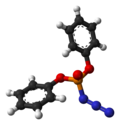 DPPA 3D balls
 -
 Acyl azide formation
 -
 Curtius rearrangement mechanism concerted
 -
 Curtius rearrangement photochemical mechanism
 -
 Curtius rearrangement nitrene insertion
 -
 Darapsky amino acid synthesis
 -
 Harger reaction scheme
 -
 Woodward triquinacene Curtius rearrangement
 -
 Ishikawa oseltamivir Curtius rearrangement


