Electrotonic potential: Difference between revisions
CSV import |
CSV import |
||
| Line 20: | Line 20: | ||
{{Neuroscience-stub}} | {{Neuroscience-stub}} | ||
<gallery> | |||
File:1223_Graded_Potentials-02.jpg|Electrotonic potential | |||
File:Cable_theory_Neuron_RC_circuit_v3.svg|Electrotonic potential | |||
</gallery> | |||
Latest revision as of 02:17, 18 February 2025
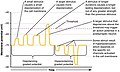
Electrotonic potential refers to the passive spread of voltage changes along a neuron's membrane. Unlike action potentials, which are active, all-or-nothing responses generated by the rapid influx and efflux of ions, electrotonic potentials diminish in strength with distance. They are crucial for the initial processing of incoming signals in the dendritic tree of neurons and play a significant role in the integration of synaptic inputs.
Overview[edit]
Electrotonic potentials are generated when a neuron's membrane potential is altered by synaptic inputs. These changes in membrane potential spread passively from their point of origin, decreasing in amplitude as they move away. This decremental nature is due to the electrical properties of the neuron's membrane and the cytoplasm's resistance to the flow of electric current.
Mechanism[edit]
The spread of electrotonic potentials is governed by the Cable theory, which describes how electrical signals propagate through the neuron's dendrites and axon. According to this theory, the extent and speed of potential spread depend on the membrane's resistance to current flow (membrane resistance), the resistance of the neuron's interior to current flow (axial resistance), and the membrane's capacitance. High membrane resistance and low axial resistance favor the farther spread of electrotonic potentials.
Functional Significance[edit]
Electrotonic potentials play a vital role in the neuron's ability to integrate synaptic inputs. They allow for the summation of inputs over time and space, enabling the neuron to respond to the overall strength of synaptic activity. This summation can occur in two forms: temporal summation, where multiple inputs arrive in quick succession at the same synapse, and spatial summation, where inputs arrive simultaneously at different locations on the neuron's membrane.
Limitations[edit]
The primary limitation of electrotonic potentials is their decremental nature. Because the potential decreases in amplitude with distance, there is a limit to how far and how effectively synaptic inputs can influence the neuron's activity. This limitation is partly overcome by the generation of action potentials, which can propagate without decrement over long distances.
Clinical Relevance[edit]
Understanding electrotonic potentials is crucial in neurology and neurophysiology, as alterations in the properties that govern these potentials can lead to neurological disorders. For example, changes in membrane resistance or axial resistance can affect the spread of electrotonic potentials, potentially disrupting neural circuit function.

This article is a neuroscience stub. You can help WikiMD by expanding it!
-
 Electrotonic potential
 -
 Electrotonic potential


