Lumbricus terrestris: Difference between revisions
CSV import Tags: mobile edit mobile web edit |
CSV import |
||
| Line 28: | Line 28: | ||
[[Category:Ecology]] | [[Category:Ecology]] | ||
{{Zoology-stub}} | {{Zoology-stub}} | ||
<gallery> | |||
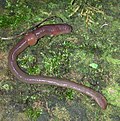
File:Lumbricus_terrestris.jpg|Lumbricus terrestris | |||
File:Regenwurm1.jpg|Regenwurm | |||
File:Earthworm_head.svg|Earthworm head | |||
</gallery> | |||
Latest revision as of 02:07, 17 February 2025
Lumbricus terrestris, commonly known as the common earthworm or nightcrawler, is a large, reddish-brown, terrestrial invertebrate that belongs to the phylum Annelida. It is widely distributed across Europe and has been introduced to North America and other parts of the world. Lumbricus terrestris plays a crucial role in soil aeration, nutrient cycling, and organic matter decomposition, making it a key species in agriculture and ecology.
Description[edit]
Lumbricus terrestris can grow up to 25-30 cm in length, making it one of the largest earthworm species. Its body is segmented, with each segment containing a set of muscles and bristles called setae, which aid in movement. The earthworm's skin is covered in mucus, which helps in respiration and moisture retention.
Habitat and Distribution[edit]
Originally from Europe, Lumbricus terrestris has been introduced to many other parts of the world, including North America, where it is now widespread. It prefers moist, temperate soils rich in organic matter. Common habitats include gardens, fields, and forests, where it burrows deeply and creates extensive tunnel systems.
Ecology and Behavior[edit]
Lumbricus terrestris is a detritivore, feeding on decomposing plant and animal material in the soil. Its burrowing activity aerates the soil, improves drainage, and helps incorporate organic matter into deeper soil layers, enhancing soil fertility and structure. This earthworm is primarily nocturnal, emerging at night to feed and mate.
Reproduction[edit]
Lumbricus terrestris is hermaphroditic, possessing both male and female reproductive organs. However, it requires a mate to reproduce. Mating occurs on the soil surface, usually at night. Following mating, each worm forms a cocoon from which juvenile worms eventually emerge.
Importance to Humans[edit]
The role of Lumbricus terrestris in soil health cannot be overstated. By improving soil structure and fertility, it benefits agricultural productivity. Additionally, it is used as bait in sport fishing and has been studied for its potential in organic waste composting and soil remediation.
Conservation[edit]
While Lumbricus terrestris is not currently considered at risk, its habitat is threatened by intensive agriculture, pollution, and urbanization. Conservation efforts focus on sustainable land management practices that protect soil health and earthworm habitats.
See Also[edit]
-
 Lumbricus terrestris
 -
 Regenwurm
 -
 Earthworm head


