Ipomoea corymbosa: Difference between revisions
CSV import |
CSV import Tags: mobile edit mobile web edit |
||
| Line 27: | Line 27: | ||
{{botany-stub}} | {{botany-stub}} | ||
<gallery> | |||
File:Rivea_corymbosa_1838.jpg|Illustration of Rivea corymbosa from 1838 | |||
File:Oliluiqui_Seeds.jpg|Oliluiqui seeds | |||
</gallery> | |||
Latest revision as of 02:09, 17 February 2025
Ipomoea corymbosa, also known as the Morning Glory Tree or by its synonym Turbina corymbosa, is a species of flowering plant in the family Convolvulaceae. This plant is native to Latin America, from Mexico to northern South America, and has been introduced to various parts of the world for its ornamental value and psychoactive properties. It is closely related to other species of Ipomoea, such as Ipomoea tricolor and Ipomoea purpurea, which are commonly known for their vibrant flowers.
Description[edit]
Ipomoea corymbosa is a perennial vine that can grow up to 5 meters in length. Its stems are slender and twining, allowing it to climb over other vegetation. The leaves are heart-shaped, 5-15 cm in length, and 4-12 cm in width. The flowers are trumpet-shaped, ranging in color from white to pink or light purple, and appear in small clusters (corymbs). The plant blooms from early summer to late autumn.
Cultivation and Uses[edit]
Ipomoea corymbosa is cultivated for its ornamental flowers and as a traditional medicine. It thrives in well-drained soil under full sun but can tolerate partial shade. Regular watering and fertilization are recommended to promote healthy growth and flowering. In traditional medicine, various parts of the plant, including the seeds, have been used for their psychoactive and hallucinogenic effects. The seeds contain ergoline alkaloids, such as lysergic acid amide (LSA), which are structurally similar to LSD.
Traditional and Medicinal Uses[edit]
In many indigenous cultures of Mexico, Ipomoea corymbosa seeds have been used in sacred ceremonies for their entheogenic properties. The seeds are consumed orally, either directly or as part of a preparation, to induce visions and spiritual experiences. Despite its traditional use, the consumption of Ipomoea corymbosa for its psychoactive effects is not without risks, as the alkaloids can cause nausea, vomiting, and other adverse reactions.
Conservation Status[edit]
While Ipomoea corymbosa is not currently listed as endangered, habitat destruction and overharvesting for ornamental and medicinal purposes pose potential threats to its populations. Conservation efforts are necessary to ensure the sustainability of this species in its native range.
See Also[edit]
References[edit]
<references/>

-
 Illustration of Rivea corymbosa from 1838
 -
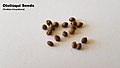 Oliluiqui seeds


