Libidibia coriaria: Difference between revisions
CSV import Tags: mobile edit mobile web edit |
CSV import |
||
| Line 30: | Line 30: | ||
[[Category:Flora of South America]] | [[Category:Flora of South America]] | ||
{{medicine-stub}} | {{medicine-stub}} | ||
<gallery> | |||
File:Caesalpinia_coriaria,_Cooktown_2010.jpg|Libidibia coriaria tree in Cooktown, 2010 | |||
File:Caesalpinia_coriaria.jpg|Libidibia coriaria foliage | |||
File:Libidibia_coriaria_plants.jpg|Libidibia coriaria plants | |||
</gallery> | |||
Latest revision as of 04:01, 18 February 2025
Libidibia coriaria, commonly known as the divi-divi tree, is a species of flowering plant in the pea family, Fabaceae. It is native to the Caribbean, Central America, and northern South America. The divi-divi is well-known for its distinctive, contorted shape, with branches spreading widely as if sculpted by the wind. This feature makes it a recognizable and iconic presence in its native landscapes. The tree is also valued for its various uses in traditional medicine, tanning, and dyeing industries.
Description[edit]
Libidibia coriaria grows as a small to medium-sized tree, typically reaching heights of 5 to 10 meters. Its most notable characteristic is its naturally twisted and bent branches, which are a result of the prevailing winds in its habitat. The leaves are compound, with small, green leaflets that provide shade and are drought-resistant. The flowers of the divi-divi tree are small, fragrant, and pink to white in color, attracting a variety of pollinators. The fruit is a large, curved pod that contains several seeds and is known for its high tannin content.
Distribution and Habitat[edit]
The divi-divi tree is indigenous to the Caribbean, Central America, and the northern regions of South America. It thrives in arid and semi-arid climates, often found in coastal areas where it can withstand strong winds and salt spray. The tree's ability to adapt to harsh environmental conditions makes it an important species for preventing soil erosion and for use in reforestation projects in degraded areas.
Uses[edit]
Tannin Extraction[edit]
The pods of Libidibia coriaria are rich in tannins, making them valuable for the leather tanning industry. The tannins extracted from the pods are used to convert animal hides into leather, a process that makes the leather more durable and resistant to decomposition.
Traditional Medicine[edit]
In traditional medicine, various parts of the divi-divi tree, including the bark, leaves, and pods, have been used to treat a range of ailments. The tree is believed to have anti-inflammatory, antiseptic, and astringent properties. Decoctions made from the bark or leaves are used in the treatment of skin conditions, digestive issues, and as a general health tonic.
Dye Production[edit]
The high tannin content in the pods also makes them a source of natural dyes. The dyes derived from Libidibia coriaria are used in the textile industry to produce a range of brown hues. Traditional artisans value the pods for their ability to produce colorfast dyes for fabrics and crafts.
Conservation[edit]
While Libidibia coriaria is not currently listed as endangered, its populations are affected by habitat loss and overexploitation for its valuable pods. Conservation efforts are focused on sustainable harvesting practices and the protection of natural habitats to ensure the long-term survival of this species.
See Also[edit]

-
 Libidibia coriaria tree in Cooktown, 2010
 -
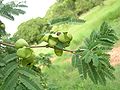 Libidibia coriaria foliage
 -
 Libidibia coriaria plants


