Farnesyl-diphosphate farnesyltransferase: Difference between revisions
CSV import Tags: mobile edit mobile web edit |
CSV import |
||
| Line 25: | Line 25: | ||
{{Enzyme-stub}} | {{Enzyme-stub}} | ||
<gallery> | |||
File:Squalene_Synthase_(Human)._Key_residues_in_the_central_channel_are_shown_as_spheres..png|Squalene Synthase (Human) - Key residues in the central channel | |||
File:SQS_Reaction.png|SQS Reaction | |||
File:SQS_Mechanism_1.png|SQS Mechanism 1 | |||
File:SQS_Mechanism_2.png|SQS Mechanism 2 | |||
File:Mevalonate_Pathway_Branching_at_FPP.png|Mevalonate Pathway Branching at FPP | |||
</gallery> | |||
Latest revision as of 04:34, 18 February 2025
Farnesyl-diphosphate farnesyltransferase (FDFT1), also known as squalene synthase, is an enzyme that plays a crucial role in the sterol biosynthesis pathway, specifically in the conversion of farnesyl diphosphate (FPP) to squalene, a key step in the biosynthesis of cholesterol. This enzyme catalyzes a two-step reaction that involves the condensation of two molecules of FPP to form squalene, a precursor for all steroids and sterols. Given its essential role in cholesterol production, FDFT1 is a target for cholesterol-lowering drugs, such as statins, and is of significant interest in the treatment of cardiovascular diseases.
Function[edit]
FDFT1 is an integral membrane enzyme found in the endoplasmic reticulum, where it catalyzes the first committed step in the biosynthesis of sterols. The enzyme's activity is regulated by cellular cholesterol levels and is subject to feedback inhibition by end products of the sterol pathway. The regulation of FDFT1 is critical for maintaining cellular cholesterol homeostasis.
Clinical Significance[edit]
Due to its pivotal role in cholesterol biosynthesis, FDFT1 is a potential target for therapeutic intervention in hypercholesterolemia and related cardiovascular diseases. Inhibitors of FDFT1, by reducing cholesterol synthesis, can potentially lower plasma cholesterol levels and reduce the risk of atherosclerosis and coronary artery disease. Research into FDFT1 inhibitors is ongoing, with the aim of developing new classes of cholesterol-lowering drugs that may offer advantages over existing therapies.
Genetics[edit]
The gene encoding farnesyl-diphosphate farnesyltransferase is located on human chromosome 8p23.1. Mutations in this gene have not been directly linked to human diseases, but due to the enzyme's role in cholesterol biosynthesis, genetic variations could potentially affect individual responses to cholesterol-lowering medications.
Pharmacology[edit]
Inhibitors of FDFT1 represent a novel approach to managing hypercholesterolemia. Unlike statins, which inhibit an earlier step in the cholesterol biosynthesis pathway, FDFT1 inhibitors directly block the synthesis of squalene, potentially offering a mechanism to lower cholesterol with a different side effect profile. The development of specific FDFT1 inhibitors is an area of active pharmaceutical research.
See Also[edit]

-
 Squalene Synthase (Human) - Key residues in the central channel
 -
 SQS Reaction
 -
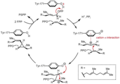 SQS Mechanism 1
 -
 SQS Mechanism 2
 -
 Mevalonate Pathway Branching at FPP
._Key_residues_in_the_central_channel_are_shown_as_spheres..png)


