Inositol trisphosphate: Difference between revisions
CSV import |
CSV import |
||
| Line 25: | Line 25: | ||
[[Category:Cell biology]] | [[Category:Cell biology]] | ||
{{Biochemistry-stub}} | {{Biochemistry-stub}} | ||
==Inositol_trisphosphate== | |||
<gallery> | |||
File:Inositol_1,4,5-trisphosphate.svg|Inositol 1,4,5-trisphosphate structure | |||
File:IP3_moleucle.png|IP3 molecule | |||
File:PIP2_cleavage_to_IP3_and_DAG.jpg|PIP2 cleavage to IP3 and DAG | |||
</gallery> | |||
Latest revision as of 03:56, 18 February 2025
Inositol trisphosphate (IP3) is a molecule that functions as a secondary messenger in cell signaling pathways. It is crucial in various biological processes, including the regulation of intracellular calcium levels, cell proliferation, and apoptosis. IP3 is derived from the phospholipid phosphatidylinositol 4,5-bisphosphate (PIP2) in the cell membrane upon activation of G protein-coupled receptors (GPCRs) or receptor tyrosine kinases (RTKs).
Biosynthesis[edit]
The biosynthesis of IP3 begins with the activation of phospholipase C (PLC), an enzyme that catalyzes the hydrolysis of PIP2 into IP3 and diacylglycerol (DAG). This reaction is triggered by various stimuli, including hormones, growth factors, and neurotransmitters, which bind to their respective receptors and activate PLC through GPCRs or RTKs.
Function[edit]
The primary function of IP3 is to mobilize calcium ions (Ca^2+) from the endoplasmic reticulum (ER) into the cytoplasm. IP3 binds to IP3 receptors (IP3R) located on the ER membrane, causing the release of Ca^2+ into the cytosol. This increase in intracellular Ca^2+ concentration serves as a signal for various cellular responses, such as muscle contraction, secretion, metabolism, and gene expression.
Signaling Pathways[edit]
IP3 is involved in several signaling pathways, including those regulating cell growth, differentiation, and survival. The interaction between IP3 and its receptors is a critical point of regulation in these pathways. Abnormalities in IP3 signaling have been implicated in various diseases, such as cancer, cardiovascular diseases, and neurological disorders.
Metabolism[edit]
After fulfilling its role, IP3 is rapidly metabolized by specific phosphatases into inositol bisphosphate (IP2), inositol monophosphate (IP1), and eventually myo-inositol, which can be recycled to regenerate PIP2. This ensures that the cell can quickly respond to new signals.
Clinical Significance[edit]
Given its role in calcium signaling and cell regulation, IP3 and its signaling pathway are targets for therapeutic intervention in several diseases. Drugs that modulate the IP3 signaling pathway have potential applications in treating conditions such as heart disease, cancer, and bipolar disorder.
See Also[edit]
.svg) | This biochemistry article is a stub. You can help Wikipedia by adding missing information. |
Inositol_trisphosphate[edit]
-
 Inositol 1,4,5-trisphosphate structure
 -
 IP3 molecule
 -
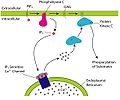 PIP2 cleavage to IP3 and DAG


