Microform: Difference between revisions
CSV import |
CSV import |
||
| Line 23: | Line 23: | ||
{{Medicine-stub}} | {{Medicine-stub}} | ||
<gallery> | |||
File:Microform scanner.JPG|Microform scanner | |||
File:Microfiche reader and source code.jpg|Microfiche reader and source code | |||
File:Library microfiche reader.jpg|Library microfiche reader | |||
File:Positive roll film.jpg|Positive roll film | |||
File:Aperture card.JPG|Aperture card | |||
File:Microfiche card.JPG|Microfiche card | |||
File:Microfiche holder.jpg|Microfiche holder | |||
File:Microcard AEC report.png|Microcard AEC report | |||
File:Poste de microfilmage en 35 mm 338-6-003.jpg|Poste de microfilmage en 35 mm | |||
File:Production et duplication de microfilms 338-3-006.jpg|Production et duplication de microfilms | |||
</gallery> | |||
Latest revision as of 05:25, 3 March 2025
Microform is a medical condition characterized by the underdevelopment of one or more body parts or organs. It is considered a milder form of a congenital anomaly, which can affect any part of the body, including the face, limbs, and internal organs. Unlike more severe congenital anomalies, microform conditions often result in structures that are present but significantly smaller or less developed than normal. This can lead to a range of physical and sometimes functional impairments, depending on the specific body parts involved.
Causes[edit]
The causes of microform conditions are varied and can include genetic and environmental factors. Genetic mutations or alterations can lead to the improper development of an organ or body part during embryonic development. Environmental factors, such as exposure to certain drugs, chemicals, or infections during pregnancy, can also contribute to the development of microform anomalies. In many cases, the exact cause remains unknown.
Diagnosis[edit]
Diagnosis of microform conditions typically involves a combination of physical examination, medical history, and imaging studies. Ultrasound during pregnancy can sometimes detect microform anomalies, depending on the organ or body part affected. After birth, more detailed imaging techniques, such as MRI (Magnetic Resonance Imaging) or CT scans (Computed Tomography), may be used to assess the extent of the condition.
Treatment[edit]
Treatment for microform conditions varies widely depending on the specific anomaly and its severity. In some cases, surgical intervention may be necessary to correct or improve the function of the underdeveloped organ or body part. For example, microform conditions affecting the limbs may require orthopedic surgery to enhance mobility or correct deformities. Other conditions might be managed with physical therapy, prosthetics, or other supportive measures to improve quality of life.
Prognosis[edit]
The prognosis for individuals with microform conditions depends on the nature and severity of the anomaly. Many people with microform anomalies lead full and active lives with appropriate medical and surgical management. Early intervention and treatment can significantly improve outcomes, especially for conditions that affect physical function.
See also[edit]
 | This medical article is a stub. You can help Wikipedia by adding missing information. |
-
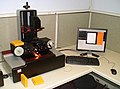 Microform scanner
 -
 Microfiche reader and source code
 -
 Library microfiche reader
 -
 Positive roll film
 -
 Aperture card
 -
 Microfiche card
 -
 Microfiche holder
 -
 Microcard AEC report
 -
 Poste de microfilmage en 35 mm
 -
 Production et duplication de microfilms


