Bicuspid aortic valve: Difference between revisions
CSV import Tags: mobile edit mobile web edit |
CSV import |
||
| Line 38: | Line 38: | ||
{{Cardiology-stub}} | {{Cardiology-stub}} | ||
<gallery> | |||
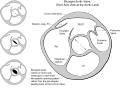
File:Bicuspid Aortic Valve.svg|Bicuspid Aortic Valve | |||
File:Heart bicuspid aortic valve.svg|Heart with Bicuspid Aortic Valve | |||
File:Heart bicuspid aortic lpla.svg|Heart Bicuspid Aortic LPLA | |||
</gallery> | |||
Revision as of 00:49, 20 February 2025
Bicuspid Aortic Valve (BAV) is a congenital heart defect characterized by the aortic valve having only two leaflets instead of the normal three. This condition affects the valve's function and is the most common congenital cardiac anomaly, present in approximately 1-2% of the population. The aortic valve plays a crucial role in directing blood flow from the heart's left ventricle to the aorta, and subsequently, to the rest of the body. BAV can lead to various complications, including aortic stenosis, aortic regurgitation, and an increased risk of aortic aneurysm and aortic dissection.
Etiology and Pathophysiology
The exact cause of Bicuspid Aortic Valve is not fully understood, but it is believed to involve a combination of genetic and environmental factors. The condition is thought to arise from abnormal cusp formation during valvular development in the fetus. BAV is associated with mutations in several genes, including NOTCH1, which plays a role in the development of the heart and its valves.
In a normal aortic valve, three cusps or leaflets open and close to regulate blood flow. In BAV, two of the cusps are fused, leading to a valve that may not function properly. This can cause the heart to work harder to pump blood, potentially leading to cardiac hypertrophy and heart failure over time.
Clinical Presentation
Patients with Bicuspid Aortic Valve may be asymptomatic or present with symptoms related to valve dysfunction or associated complications. Symptoms can include: - Shortness of breath - Fatigue - Chest pain - Heart murmur, detected by a healthcare provider during a physical examination
Diagnosis
Diagnosis of BAV typically involves imaging techniques such as echocardiography, which allows for detailed visualization of the valve structure and function. Other diagnostic tools may include magnetic resonance imaging (MRI) and computed tomography (CT) scans, particularly for assessing associated conditions like aortic aneurysm.
Management and Treatment
The management of Bicuspid Aortic Valve depends on the severity of the condition and the presence of symptoms or complications. Regular monitoring through echocardiography is recommended for asymptomatic individuals. Treatment options for those with significant valve dysfunction or complications may include: - Medication to manage symptoms or reduce the risk of complications - Surgical repair or replacement of the aortic valve - Surveillance and management of aortic aneurysm or dissection
Prognosis
The prognosis for individuals with Bicuspid Aortic Valve varies depending on the presence and severity of valve dysfunction and associated complications. With appropriate management, many individuals can lead normal, active lives.
Epidemiology
Bicuspid Aortic Valve is the most common congenital heart defect, affecting approximately 1-2% of the general population. It is more commonly diagnosed in males than females.
See Also
- Heart valve - Congenital heart defect - Aortic valve replacement

This article is a cardiovascular system stub. You can help WikiMD by expanding it!
-
 Bicuspid Aortic Valve
 -
 Heart with Bicuspid Aortic Valve
 -
 Heart Bicuspid Aortic LPLA


