Anterior compartment of leg: Difference between revisions
CSV import |
CSV import |
||
| Line 36: | Line 36: | ||
[[Category:Musculoskeletal system]] | [[Category:Musculoskeletal system]] | ||
[[Category:Medical conditions related to lower limb]] | [[Category:Medical conditions related to lower limb]] | ||
<gallery> | |||
File:Anterior_compartment_of_leg_-_Tibialis_anterior.png|Tibialis anterior | |||
File:Anterior_compartment_of_leg_-_Extensor_hallucis_longus.png|Extensor hallucis longus | |||
File:Anterior_compartment_of_leg_-_Extensor_digitorum_longus.png|Extensor digitorum longus | |||
File:Anterior_compartment_of_leg_-_Fibularis_tertius.png|Fibularis tertius | |||
File:Anterior_compartment_of_leg_-_animation.gif|Animation of anterior compartment of leg | |||
</gallery> | |||
Latest revision as of 21:03, 25 February 2025
Anterior compartment of leg refers to one of the anatomical compartments in the lower leg, housing muscles that primarily facilitate dorsiflexion of the foot and extension of the toes. This compartment is significant not only for its role in locomotion but also in various medical conditions, such as compartment syndrome.
Anatomy[edit]
The anterior compartment is bounded by the tibia and fibula bones medially and laterally, respectively, the anterior intermuscular septum, and the deep fascia of the leg. It is one of the four compartments in the lower leg, the others being the lateral, superficial posterior, and deep posterior compartments.
Muscles[edit]
The anterior compartment contains the following muscles:
- Tibialis anterior: Responsible for dorsiflexion and inversion of the foot.
- Extensor hallucis longus: Extends the big toe and assists in dorsiflexion of the foot.
- Extensor digitorum longus: Extends the toes and assists in dorsiflexion of the foot.
- Peroneus tertius (also known as fibularis tertius): Assists in dorsiflexion and eversion of the foot.
These muscles are innervated by the deep peroneal nerve, and the blood supply comes from the anterior tibial artery.
Function[edit]
The primary function of the anterior compartment muscles is to facilitate the dorsiflexion of the foot at the ankle joint and extension of the toes. This action is crucial for the 'heel strike' and 'foot flat' phases of the gait cycle, allowing for smooth transition and propulsion of the body forward during walking and running.
Clinical Significance[edit]
- Compartment Syndrome###
The anterior compartment is susceptible to compartment syndrome, a condition where increased pressure within the compartment compromises blood flow and nerve function, potentially leading to muscle and nerve damage. Acute compartment syndrome is a medical emergency, often caused by trauma, requiring immediate intervention to prevent permanent damage.
- Shin Splints###
Shin splints is a term often used to describe pain along the tibia, which can be associated with overuse injuries affecting the anterior compartment muscles. Proper rest, physiotherapy, and gradual return to activity are key to management.
Diagnosis and Treatment[edit]
Diagnosis of conditions affecting the anterior compartment often involves a combination of clinical examination, imaging studies such as MRI or ultrasound, and compartment pressure testing for compartment syndrome. Treatment varies from conservative management, such as rest and physiotherapy, to surgical interventions like fasciotomy for compartment syndrome.
See Also[edit]
-
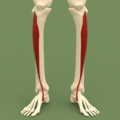 Tibialis anterior
 -
 Extensor hallucis longus
 -
 Extensor digitorum longus
 -
 Fibularis tertius
 -
 Animation of anterior compartment of leg


