New York Cancer Hospital: Difference between revisions
CSV import Tags: mobile edit mobile web edit |
CSV import Tags: mobile edit mobile web edit |
||
| Line 26: | Line 26: | ||
[[Category:History of medicine]] | [[Category:History of medicine]] | ||
{{hospital-stub}} | {{hospital-stub}} | ||
<gallery> | |||
File:455_Central_Park_West.jpg|New York Cancer Hospital | |||
File:Feat.184.3.640.jpg|New York Cancer Hospital | |||
File:491_NEW-YORK_CANCER_HOSPITAL,_CENTRAL_PARK_WEST_AND_106TH_STREET.jpg|New York Cancer Hospital, Central Park West and 106th Street | |||
File:455_Central_Park_West_from_east.jpg|New York Cancer Hospital from east | |||
</gallery> | |||
Latest revision as of 04:38, 18 February 2025
New York Cancer Hospital (NYCH), also known historically as the Cancer Hospital of New York, was a pioneering institution in the field of oncology, established in the late 19th century. It was among the first hospitals in the United States dedicated solely to the treatment and research of cancer. Over the years, NYCH has played a crucial role in the development of cancer treatments and patient care protocols, contributing significantly to the field of oncology.
History[edit]
The New York Cancer Hospital was founded in 1884, in response to the growing need for specialized care and research facilities for cancer patients. The hospital was the brainchild of a group of philanthropists and physicians who recognized the importance of addressing cancer, a disease that was becoming increasingly prevalent in the late 19th century. The original building, located on the Upper West Side of Manhattan, was designed by architect Charles Coolidge Haight, featuring a distinctive round design intended to minimize the accumulation of dirt and germs.
Mission and Vision[edit]
The mission of the New York Cancer Hospital was to provide comprehensive care to cancer patients, while also conducting research to advance the understanding and treatment of the disease. The vision was to create a world where cancer could be effectively treated or even prevented, improving the quality of life for patients and their families.
Advancements and Contributions[edit]
Throughout its history, the New York Cancer Hospital made significant contributions to the field of oncology. It was among the first to implement radium therapy as a treatment for cancer, following the discovery of radium's potential therapeutic effects by Marie Curie. The hospital also played a key role in the development of surgical techniques and chemotherapy protocols that have become standard treatments for various types of cancer.
Facilities and Services[edit]
The hospital was equipped with state-of-the-art facilities for its time, including surgical suites, radiation therapy rooms, and laboratories for research. It provided a range of services, from diagnosis and treatment to palliative care and support for patients and their families. The hospital's staff included some of the leading oncologists, surgeons, and researchers of the era, dedicated to providing the best possible care for their patients.
Legacy[edit]
The New York Cancer Hospital has left a lasting legacy in the field of oncology. Its pioneering work laid the foundation for modern cancer treatment and research. Although the original hospital building no longer serves its initial purpose, the institution's contributions continue to impact the lives of cancer patients around the world.
See Also[edit]

-
 New York Cancer Hospital
 -
 New York Cancer Hospital
 -
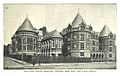 New York Cancer Hospital, Central Park West and 106th Street
 -
 New York Cancer Hospital from east


