Rhodobacteraceae: Difference between revisions
CSV import Tags: mobile edit mobile web edit |
CSV import |
||
| Line 33: | Line 33: | ||
{{bacteria-stub}} | {{bacteria-stub}} | ||
{{medicine-stub}} | {{medicine-stub}} | ||
<gallery> | |||
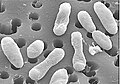
File:Roseobacter strain HIMB11.jpg|Roseobacter strain HIMB11 | |||
</gallery> | |||
Latest revision as of 05:55, 3 March 2025
Rhodobacteraceae[edit]
The Rhodobacteraceae are a family of proteobacteria, specifically belonging to the class Alphaproteobacteria. They are gram-negative, aerobically respiring, and rod-shaped. The family is named after the genus Rhodobacter, which is known for its purple pigmentation.
Characteristics[edit]
Members of the Rhodobacteraceae family are known for their metabolic versatility. They are capable of photosynthesis, but unlike plants, they do not produce oxygen. Instead, they use bacteriochlorophyll a or b, along with various carotenoids, to capture light energy. This process is known as anoxygenic photosynthesis.
Ecology[edit]
Rhodobacteraceae are found in a variety of environments, including marine, freshwater, and terrestrial habitats. They play important roles in the carbon cycle and nitrogen cycle, and some species are also involved in the sulfur cycle.
Genera[edit]
The Rhodobacteraceae family includes several genera, such as Rhodobacter, Rhodovulum, Rhodobaca, Rhodothalassium, and Rhodopila. Each of these genera has unique characteristics and ecological roles.
Medical relevance[edit]
While Rhodobacteraceae are primarily environmental bacteria, some species have been associated with human disease. For example, Rhodobacter sphaeroides has been implicated in cases of endocarditis and septicemia.
See also[edit]
References[edit]
<references />


-
 Roseobacter strain HIMB11

