Cultural Revolution: Difference between revisions
CSV import |
CSV import |
||
| Line 25: | Line 25: | ||
{{China-stub}} | {{China-stub}} | ||
{{medicine-stub}} | {{medicine-stub}} | ||
<gallery> | |||
File:Cultural Revolution poster.jpg|Cultural Revolution poster | |||
File:Luo Ruiqing.jpg|Luo Ruiqing | |||
File:人民日报516.jpg|People's Daily May 16 | |||
File:1966-08 1966年横扫一切牛鬼蛇神.jpg|1966 Sweep Away All Monsters and Demons | |||
File:1966-09 1966年毛泽东.jpg|1966 Mao Zedong | |||
File:LiuShaoqi Colour.jpg|Liu Shaoqi | |||
File:1966-10 1966年毛泽东游长江2.jpg|1966 Mao Zedong swimming in the Yangtze | |||
File:1967-11 1967年 北京师范大学大字报批评刘少奇.jpg|1967 Beijing Normal University big-character poster criticizing Liu Shaoqi | |||
File:1967-11 1967年 北京大学大字报.jpg|1967 Peking University big-character poster | |||
File:Guangmei cultural revolution.jpg|Guangmei Cultural Revolution | |||
</gallery> | |||
Latest revision as of 06:17, 3 March 2025
Cultural Revolution
The Cultural Revolution, formally the Great Proletarian Cultural Revolution, was a sociopolitical movement in the People's Republic of China that took place from 1966 until 1976. Set into motion by Mao Zedong, then Chairman of the Communist Party of China, its stated goal was to preserve Chinese Communism by purging remnants of capitalist and traditional elements from Chinese society, and to re-impose Mao Zedong Thought (known outside China as Maoism) as the dominant ideology in the PRC.
Background[edit]
The Cultural Revolution marked the return of Mao Zedong to a position of power after a period of less radical leadership in the Chinese Communist Party. Mao launched the Cultural Revolution to reassert his authority and ensure the party's ideology remained pure, particularly his own variant of Marxism–Leninism, known as Maoism.
Impact on Health and Medicine[edit]
The Cultural Revolution had a significant impact on health and medicine in China. Traditional Chinese medicine, which had been viewed with suspicion by the Communist Party, was given a new lease of life. The Party promoted traditional medicine as a way to reach the masses who could not access Western-style medical facilities. This led to the development of the barefoot doctor program, which trained farmers in basic health care and family planning services.
However, the Cultural Revolution also led to a decline in the standards of medical education and research. Many medical schools were closed, and the curriculum was politicized. The emphasis was on political loyalty rather than medical expertise.
Legacy[edit]
The Cultural Revolution has been extensively studied and is often cited as an example of the far-reaching impact of political ideology on society and culture. Its effects on health and medicine in China are still felt today, with a dual system of Western and traditional Chinese medicine existing side by side.


-
Cultural Revolution poster
-
Luo Ruiqing
-
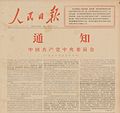 People's Daily May 16
 -
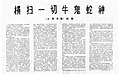 1966 Sweep Away All Monsters and Demons
 -
 1966 Mao Zedong
 -
Liu Shaoqi
-
 1966 Mao Zedong swimming in the Yangtze
 -
 1967 Beijing Normal University big-character poster criticizing Liu Shaoqi
 -
 1967 Peking University big-character poster
 -
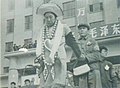 Guangmei Cultural Revolution


