CHOP (chemotherapy): Difference between revisions
From WikiMD's Wellness Encyclopedia
CSV import |
CSV import |
||
| Line 26: | Line 26: | ||
{{Hematology-stub}} | {{Hematology-stub}} | ||
{{medicine-stub}} | {{medicine-stub}} | ||
<gallery> | |||
File:R-CHOP_infusion_(R,C,H,O_components).jpg|R-CHOP infusion (R, C, H, O components) | |||
</gallery> | |||
Latest revision as of 21:59, 16 February 2025
CHOP is a chemotherapy regimen for non-Hodgkin lymphoma (NHL) consisting of four drugs: Cyclophosphamide, Hydroxydaunorubicin, Oncovin, and Prednisone. The regimen has been in use since the 1970s.
Overview[edit]
CHOP is used to treat non-Hodgkin lymphoma, including diffuse large B-cell lymphoma (DLBCL). The regimen is given in cycles, with each cycle typically lasting three weeks. Patients usually receive six to eight cycles.
Components[edit]
The CHOP chemotherapy regimen consists of the following drugs:
- Cyclophosphamide: An alkylating agent that prevents cell division by cross-linking DNA strands and decreasing DNA synthesis.
- Hydroxydaunorubicin (also known as Doxorubicin): An anthracycline that intercalates DNA, inhibits topoisomerase II, and creates free radicals.
- Oncovin (also known as Vincristine): A vinca alkaloid that inhibits mitosis by binding to tubulin.
- Prednisone: A corticosteroid that induces apoptosis in lymphocytes.
Side Effects[edit]
Like all chemotherapy regimens, CHOP has potential side effects, including nausea, vomiting, hair loss, and fatigue. More serious side effects can include cardiotoxicity and neutropenia.
See Also[edit]
| Chemotherapy | ||||||||||
|---|---|---|---|---|---|---|---|---|---|---|
This Chemotherapy related article is a stub.
|

This article is a hematology stub. You can help WikiMD by expanding it!

-
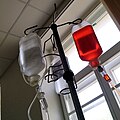 R-CHOP infusion (R, C, H, O components)
.jpg)
