Product (chemistry): Difference between revisions
CSV import Tags: mobile edit mobile web edit |
CSV import |
||
| Line 34: | Line 34: | ||
[[Category:Chemical reactions]] | [[Category:Chemical reactions]] | ||
{{chemistry-stub}} | {{chemistry-stub}} | ||
<gallery> | |||
File:Methane-combustion.svg|Diagram of methane combustion reaction | |||
File:lactose_hydrolysis.svg|Illustration of lactose hydrolysis process | |||
File:Psoriasis_fingernail.jpg|Image showing psoriasis on a fingernail | |||
</gallery> | |||
Latest revision as of 00:52, 18 February 2025
Product (chemistry)
In chemistry, a product is a substance that is formed as the result of a chemical reaction. In a reaction, starting materials called reactants interact with each other. After passing through a high energy transition state (this can be thought of as the top of a hill that must be climbed), the chemical reaction gives out the products.
Formation of Products[edit]
The formation of products in a chemical reaction is influenced by several factors, including the chemical species, the temperature, the pressure, and the presence of catalysts. The rate at which products are formed in a chemical reaction is described by the rate equation.
Types of Products[edit]
Products can be categorized into several types based on the type of chemical reaction from which they are formed:
- Combustion Products: These are products formed from a combustion reaction. Common examples include carbon dioxide and water.
- Redox Products: These are products formed from a redox (reduction-oxidation) reaction. An example is the formation of iron(III) oxide from iron and oxygen.
- Acid-Base Products: These are products formed from an acid-base reaction. An example is the formation of salt and water from an acid and a base.
- Precipitation Products: These are products formed from a precipitation reaction. An example is the formation of a solid precipitate from two aqueous solutions.
See Also[edit]
References[edit]
<references />

-
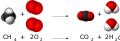 Diagram of methane combustion reaction
 -
 Illustration of lactose hydrolysis process
 -
 Image showing psoriasis on a fingernail


