Self-immolation: Difference between revisions
CSV import |
CSV import |
||
| Line 19: | Line 19: | ||
{{medicine-stub}} | {{medicine-stub}} | ||
<gallery> | |||
File:Thích_Quảng_Đức_self-immolation.jpg|Thích Quảng Đức self-immolation | |||
File:The_Burning_of_the_Rajput_women,_during_the_siege_of_Chitor.jpg|The Burning of the Rajput women, during the siege of Chitor | |||
File:Ibn_Sayyid_Murad_al-Husayni_-_Hindu_Couple_United_on_the_Funeral_Pyre_-_Walters_W64919B_-_Full_Page.jpg|Hindu Couple United on the Funeral Pyre | |||
File:Самосожигатели.jpg|Самосожигатели | |||
File:Laisvės_al._Romas_kalanta.JPG|Laisvės al. Romas Kalanta | |||
File:73.Rally.AaronBushnellVigil.WDC.26February2024_(53561768103).jpg|73. Rally Aaron Bushnell Vigil WDC 26 February 2024 | |||
</gallery> | |||
Latest revision as of 00:58, 27 February 2025
Self-immolation is the act of killing oneself, typically for political or religious reasons, particularly by setting oneself on fire. It is a form of protest or martyrdom, and has a long history in various cultures and religions.
History[edit]
The act of self-immolation has been practiced for centuries across different cultures and religions. In Buddhism, self-immolation is known as auto-cremation and has been practiced as a form of protest against religious persecution. In Hinduism, a widow would self-immolate on her husband's funeral pyre, a practice known as sati.
Psychology[edit]
From a psychological perspective, self-immolation is often seen as an act of desperation and extreme distress. It is a highly lethal method of suicide, with a mortality rate of around 95%.
Medical implications[edit]
The medical implications of self-immolation are severe. Burns from self-immolation are typically full-thickness burns, which are the most severe type of burn. They can cause extensive damage to the skin, underlying tissues, and organs. Treatment typically involves burn care, which can include fluid resuscitation, pain management, wound care, and sometimes surgery.
Prevention[edit]
Prevention of self-immolation involves addressing the underlying causes, which can include political oppression, religious persecution, and mental health issues. This can involve advocacy, mental health support, and social change.
 | This medical article is a stub. You can help WikiMD by expanding the page. |
-
 Thích Quảng Đức self-immolation
 -
 The Burning of the Rajput women, during the siege of Chitor
 -
 Hindu Couple United on the Funeral Pyre
 -
 Самосожигатели
 -
 Laisvės al. Romas Kalanta
 -
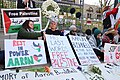 73. Rally Aaron Bushnell Vigil WDC 26 February 2024


.jpg)
