Thyromimetic: Difference between revisions
CSV import |
CSV import |
||
| Line 33: | Line 33: | ||
{{pharmacology-stub}} | {{pharmacology-stub}} | ||
== Thyromimetic == | |||
<gallery> | |||
File:Triiodothyronine_200.svg|Triiodothyronine structure | |||
File:Sobetirome_v2.svg|Sobetirome structure | |||
File:Omzotirome.svg|Omzotirome structure | |||
File:Eprotirome.svg|Eprotirome structure | |||
File:VK2809.svg|VK2809 structure | |||
File:Resmetirom_skeletal.svg|Resmetirom skeletal structure | |||
</gallery> | |||
Latest revision as of 04:45, 18 February 2025
Thyromimetics are a type of pharmacological agent that mimic the actions of the thyroid hormone. They are used in the treatment of various thyroid disorders, including hypothyroidism and thyroid cancer.
Mechanism of Action[edit]
Thyromimetics work by binding to thyroid hormone receptors in the body, which are located in the nucleus of cells. This binding activates the receptors, leading to an increase in metabolic rate, protein synthesis, and overall cell growth and differentiation.
Uses[edit]
Thyromimetics are primarily used in the treatment of hypothyroidism, a condition in which the thyroid gland does not produce enough thyroid hormone. They can also be used in the treatment of thyroid cancer, as they can help to shrink tumors and slow the progression of the disease.
Side Effects[edit]
Like all medications, thyromimetics can have side effects. These can include palpitations, insomnia, weight loss, and anxiety. In rare cases, they can also cause osteoporosis and cardiac arrhythmias.
Examples[edit]
Examples of thyromimetics include levothyroxine, liothyronine, and thyroid extract. Levothyroxine is the most commonly prescribed thyromimetic, and is typically taken once a day.
See Also[edit]
References[edit]
<references />

Thyromimetic[edit]
-
 Triiodothyronine structure
 -
 Sobetirome structure
 -
 Omzotirome structure
 -
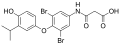 Eprotirome structure
 -
 VK2809 structure
 -
 Resmetirom skeletal structure


