Split pea: Difference between revisions
CSV import |
CSV import |
||
| Line 38: | Line 38: | ||
{{food-stub}} | {{food-stub}} | ||
<gallery> | |||
File:Split_pea.jpg|Split pea | |||
File:A_sack_of_split_peas_awaits_distribution_at_a_joint_WFP_ACTED_site_in_central_Bamako,_Mali_(8511068596).jpg|A sack of split peas awaits distribution at a joint WFP ACTED site in central Bamako, Mali | |||
</gallery> | |||
Latest revision as of 02:11, 18 February 2025
Split pea is a type of legume, specifically a variety of the pea grown specifically for drying. Split peas are high in protein and fiber, and are often used in soups and stews.
History[edit]
Split peas have a long history of cultivation dating back thousands of years. They were a staple food in the ancient civilizations of Egypt, Greece, and Rome. In the Middle Ages, they became a common food in Europe, particularly in the colder northern regions where they could be stored for long periods.
Cultivation[edit]
Split peas are grown in many parts of the world, but the largest producers are Canada, France, and China. They are typically sown in the spring and harvested in the late summer or early fall. The peas are then dried and split along a natural seam, hence the name "split pea."
Nutritional Value[edit]
Split peas are a rich source of protein, fiber, and several important vitamins and minerals. They are low in fat and contain no cholesterol, making them a healthy choice for those following a vegetarian or vegan diet.
Culinary Uses[edit]
Split peas are most commonly used in the preparation of soup, particularly split pea soup, which is a traditional dish in many cultures. They can also be used in stews, salads, and side dishes. In Indian cuisine, split peas are often used to make dal, a type of thick, spicy stew.
See Also[edit]

-
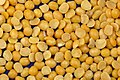 Split pea
 -
 A sack of split peas awaits distribution at a joint WFP ACTED site in central Bamako, Mali

.jpg)
