Tea bag: Difference between revisions
CSV import |
CSV import |
||
| Line 20: | Line 20: | ||
{{Food-stub}} | {{Food-stub}} | ||
<gallery> | |||
File:Tea_bag.JPG|Tea bag | |||
File:Teebeutel_Polylactid_2009.jpg|Teebeutel Polylactid 2009 | |||
File:Tea_bags.jpg|Tea bags | |||
File:Irish_Teabag.jpg|Irish Teabag | |||
File:For_your_tea_bag.jpg|For your tea bag | |||
</gallery> | |||
Latest revision as of 04:56, 18 February 2025
Tea bag is a small, porous, sealed bag or packet, typically square or rectangular, containing tea leaves, which is immersed in water to steep and make an infusion. Originally used only for tea (Camellia sinensis), they are now made with other tisanes as well. Tea bags are commonly made of filter paper or food-grade plastic, or occasionally of silk cotton or silk. The tea bag performs the same function as a tea infuser.
History[edit]
The first tea bags were made from silk muslin, and were hand-sewn. They were invented in the early 20th century by Thomas Sullivan, a tea and coffee importer from New York, who shipped his silk tea bags around the world. The loose tea was intended to be removed from the sample bags by customers, but they found it easier to brew the tea with the tea still enclosed in the porous bag.
Design and usage[edit]
The tea bag paper used in tea bags today is a blend of wood and vegetable fibers. The vegetable fiber is bleached pulp abaca hemp, a plantation banana plant grown for its fiber, mostly in the Philippines and Colombia. Some bags have a heat-sealable thermoplastic such as PVC or polypropylene as a component fiber on the tea bag surface.
Environmental considerations[edit]
Some types of tea bags have been criticized for environmental reasons. Most tea bags are made from paper, with a small amount of plastic used to seal them shut. However, some tea bags are made entirely from plastic. Plastic tea bags can shed microplastics into the tea.
See also[edit]

-
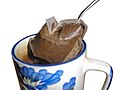 Tea bag
 -
 Teebeutel Polylactid 2009
 -
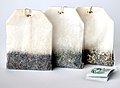 Tea bags
 -
 Irish Teabag
 -
 For your tea bag


