Static electricity: Difference between revisions
CSV import |
CSV import |
||
| Line 32: | Line 32: | ||
[[Category:Electricity]] | [[Category:Electricity]] | ||
{{Physics-stub}} | {{Physics-stub}} | ||
<gallery> | |||
File:Static_on_the_playground_(48616367).jpg|Static electricity on the playground | |||
File:Cat_demonstrating_static_cling_with_styrofoam_peanuts.jpg|Cat demonstrating static cling with styrofoam peanuts | |||
File:Antistatic_bag.jpg|Antistatic bag | |||
File:AntiStatic-Wrist-Guard.jpg|AntiStatic wrist guard | |||
File:Lightning_strike_jan_2007.jpg|Lightning strike | |||
File:Hairthunderstorm.png|Hair standing up due to static electricity | |||
File:Airbus_A321-231_-_British_Airways_-_G-EUXH_-_EHAM_(5).jpg|Airbus A321-231 with static electricity | |||
File:Ozone_cracks_in_tube1.jpg|Ozone cracks in tube due to static electricity | |||
</gallery> | |||
Latest revision as of 11:45, 18 February 2025
Static Electricity is a form of electricity that results from an imbalance of electric charge within or on the surface of a material. This imbalance of charges can be caused by certain conditions, such as friction, which can result in an accumulation of electrons.
Overview[edit]
Static electricity is named in contrast with current electricity, which flows through wires or other conductive paths. In the case of static electricity, the charges remain in one area rather than flowing to another. This can cause a variety of effects, such as the attraction of light objects, like dust or paper, to a charged object.
Causes[edit]
Static electricity is usually caused when certain materials are rubbed together. The process causes electrons, which are negatively charged, to be transferred from one material to another. The material that loses electrons becomes positively charged, while the material that gains electrons is negatively charged.
Effects[edit]
The effects of static electricity are familiar to most people because it can be observed in everyday life. For example, a static charge can cause a shock when someone touches a doorknob after walking across a carpeted floor. It can also cause hair to stand on end or clothes to cling together.
Applications[edit]
Static electricity has many practical applications. It is used in photocopiers and laser printers to attract toner particles onto paper. It is also used in air purifiers to attract dust particles onto plates. In industry, it is used to prevent the build-up of static electricity, which can cause sparks and potentially ignite flammable gases or dust.
Safety[edit]
While static electricity is usually harmless, it can be a safety hazard in some situations. For example, static electricity can ignite flammable materials or gases, which is a particular concern in industries such as petroleum refining and grain handling.
See also[edit]

-
 Static electricity on the playground
 -
 Cat demonstrating static cling with styrofoam peanuts
 -
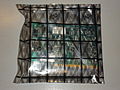 Antistatic bag
 -
 AntiStatic wrist guard
 -
 Lightning strike
 -
 Hair standing up due to static electricity
 -
 Airbus A321-231 with static electricity
 -
 Ozone cracks in tube due to static electricity
.jpg)


.jpg)

