Steam turbine: Difference between revisions
CSV import Tags: mobile edit mobile web edit |
CSV import |
||
| Line 28: | Line 28: | ||
[[Category:Thermal power station technology]] | [[Category:Thermal power station technology]] | ||
{{Energy-stub}} | {{Energy-stub}} | ||
<gallery> | |||
File:Dampfturbine_Laeufer01.jpg|Steam turbine | |||
File:TMW_773_-_Steam_turbine_generator_set.jpg|Steam turbine | |||
File:Turbinia_At_Speed.jpg|Steam turbine | |||
File:Dampfturbine_Montage01.jpg|Steam turbine | |||
File:Turbines_impulse_v_reaction.svg|Steam turbine | |||
File:AEG_marine_steam_turbine_(Rankin_Kennedy,_Modern_Engines,_Vol_VI).jpg|Steam turbine | |||
File:BalNPP_m_st2.jpg|Steam turbine | |||
File:Starboard_turbine_sets_of_Furutaka_and_Aoba_class_cruisers.svg|Steam turbine | |||
File:Turbine_Philippsburg-1.jpg|Steam turbine | |||
File:TurbineBlades.jpg|Steam turbine | |||
File:Edited_blade_design_1.png|Steam turbine | |||
File:Edited_cdn.png|Steam turbine | |||
</gallery> | |||
Latest revision as of 12:22, 18 February 2025
Steam turbine is a mechanical device that extracts thermal energy from pressurized steam, and converts it into mechanical work on a rotating output shaft. Its modern manifestation was invented by Charles Parsons in 1884.
History[edit]
The first device that can be classified as a reaction steam turbine is the aeolipile proposed by Hero of Alexandria, during the 1st century AD. In this device, steam was supplied through a hollow rotating shaft to a hollow rotating sphere. It then escaped through two opposing curved tubes, producing a reaction thrust from the steam exiting the tubes. More modern steam turbines were proposed by multiple engineers, such as William Levedis and Giovanni Branca, but it was Charles Parsons who produced the first commercially successful example in 1884.
Principle of operation and design[edit]
A steam turbine operates on the principle of thermodynamics. The high-pressure steam expands in the turbine, and in so doing, gives up its energy. The steam is then condensed and pumped back into the boiler to repeat the cycle. The stages of this process are known as Rankine cycle.
Steam turbines are made up of stages. Each stage is made up of a set of moving blades and a set of fixed blades. The fixed blades act as nozzles and direct the steam onto the moving blades. The moving blades then move due to the force of the steam.
Types of steam turbines[edit]
There are two main types of steam turbines: impulse turbines and reaction turbines. Impulse turbines change the direction of flow of a high velocity fluid or gas jet. The resulting impulse spins the turbine and leaves the fluid flow with diminished kinetic energy. Reaction turbines develop torque by reacting to the gas or fluid's pressure or mass.
Applications[edit]
Steam turbines are used in many different areas, some of which include driving electric generators in thermal power plants (fossil-fuel or nuclear), in large scale marine propulsion, and in processes where large amounts of steam are available.
See also[edit]
References[edit]
<references />

-
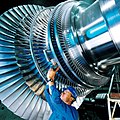 Steam turbine
 -
 Steam turbine
 -
 Steam turbine
 -
 Steam turbine
 -
 Steam turbine
 -
 Steam turbine
 -
 Steam turbine
 -
 Steam turbine
 -
 Steam turbine
 -
 Steam turbine
 -
 Steam turbine
 -
 Steam turbine


.jpg)


