Marburg virus: Difference between revisions
CSV import |
CSV import |
||
| Line 27: | Line 27: | ||
[[Category:Zoonoses]] | [[Category:Zoonoses]] | ||
{{Virus-stub}} | {{Virus-stub}} | ||
== Marburg_virus == | |||
<gallery> | |||
File:Marburg_virus.jpg|Marburg virus | |||
File:Marburg_em1986.png|Marburg em1986 | |||
File:Viruses-04-01878-g005.webp|Viruses-04-01878-g005 | |||
File:137488_web.jpg|137488 web | |||
File:Marburg_Virus_Particle_(30971357537).jpg|Marburg Virus Particle (30971357537) | |||
File:Viruses-04-01878-g007.webp|Viruses-04-01878-g007 | |||
File:Viruses-04-01878-g001-A.jpg|Viruses-04-01878-g001-A | |||
</gallery> | |||
Latest revision as of 21:20, 23 February 2025
Marburg virus is a virological agent that causes Marburg virus disease, a severe and often fatal type of hemorrhagic fever in humans and non-human primates. The virus is considered to be extremely dangerous and is classified as a Biosafety Level 4 pathogen.
History[edit]
The Marburg virus was first recognized in 1967 when outbreaks of hemorrhagic fever occurred simultaneously in laboratories in Marburg and Frankfurt, Germany and in Belgrade, Yugoslavia (now Serbia). The first people infected had been exposed to African green monkeys or their tissues while conducting research. The virus is named after Marburg, the city in Germany where one of the first outbreaks occurred.
Virology[edit]
Marburg virus is a member of the Filoviridae family, a group of related viruses that form filamentous infectious viral particles. It is closely related to the Ebola virus, the other member of the Filoviridae family capable of causing severe disease in humans.
Transmission[edit]
The exact mode of transmission of Marburg virus is not known. However, it is believed that humans may be initially infected through contact with an infected animal. After the initial transmission, the virus can be spread from person-to-person via direct contact with the blood, secretions, or other bodily fluids of infected persons, or from contact with environments contaminated with such fluids.
Symptoms and Treatment[edit]
Symptoms of Marburg virus disease include fever, chills, headache, and myalgia. As the disease progresses, a maculopapular rash may occur, and the patient may experience nausea, vomiting, chest pain, sore throat, abdominal pain, and diarrhea.
There is no specific antiviral treatment for Marburg virus disease. Patients are given supportive care, which may include rehydration with oral or intravenous fluids, and treatment of specific symptoms.
Prevention and Control[edit]
Prevention includes reducing the risk of wildlife-to-human transmission and human-to-human transmission. Control measures include prompt and safe burial of the dead, identifying people who may have been in contact with someone infected with Marburg virus, and separating the healthy from the sick.

Marburg_virus[edit]
-
 Marburg virus
 -
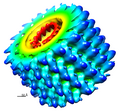 Marburg em1986
 -
 Viruses-04-01878-g005
 -
 137488 web
 -
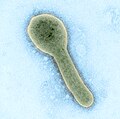 Marburg Virus Particle (30971357537)
 -
 Viruses-04-01878-g007
 -
 Viruses-04-01878-g001-A


.jpg)


