Cerebellar hemisphere: Difference between revisions
CSV import |
CSV import |
||
| Line 32: | Line 32: | ||
[[Category:Brain]] | [[Category:Brain]] | ||
{{neuroscience-stub}} | {{neuroscience-stub}} | ||
<gallery> | |||
File:Cerebellar_hemisphere_by_Sanjoy_Sanyal.webmsd.webm|Cerebellar hemisphere by Sanjoy Sanyal | |||
File:Human_cerebellum_anterior_view_description.JPG|Human cerebellum anterior view description | |||
</gallery> | |||
Latest revision as of 21:02, 23 February 2025
Cerebellar Hemisphere
The cerebellar hemisphere is a significant part of the human brain that plays a crucial role in motor control and coordination. It is one of the two halves of the cerebellum, which is located at the base of the brain, just above the brainstem. The cerebellar hemisphere is primarily responsible for the coordination of voluntary movements, balance, and muscle tone.
Structure[edit]
The cerebellar hemisphere is divided into three lobes: the anterior lobe, the posterior lobe, and the flocculonodular lobe. Each lobe has a distinct function and is further divided into smaller sections known as folia. The folia are thin, parallel folds that increase the surface area of the cerebellum, allowing for a greater number of neurons to be housed.
Function[edit]
The primary function of the cerebellar hemisphere is to coordinate voluntary movements. It receives information from the sensory systems, the spinal cord, and other parts of the brain, and then integrates these inputs to fine-tune motor activity. The cerebellar hemisphere is also involved in motor learning, helping the body to adapt and improve movements over time.
In addition to motor control, the cerebellar hemisphere plays a role in cognitive functions. Recent research suggests that it may contribute to tasks such as attention, language processing, and emotion regulation.
Clinical Significance[edit]
Damage to the cerebellar hemisphere can result in a range of neurological disorders, collectively known as cerebellar ataxia. Symptoms of cerebellar ataxia can include unsteady gait, poor coordination, and difficulty with fine motor tasks. Treatment typically involves physical therapy to help manage symptoms and improve quality of life.
See Also[edit]
References[edit]
<references group="" responsive="1"></references>

This article is a neuroscience stub. You can help WikiMD by expanding it!
-
 Cerebellar hemisphere by Sanjoy Sanyal
 -
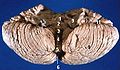 Human cerebellum anterior view description

