Carpal bones: Difference between revisions
CSV import Tags: mobile edit mobile web edit |
CSV import Tags: mobile edit mobile web edit |
||
| Line 50: | Line 50: | ||
[[Category:Orthopedics]] | [[Category:Orthopedics]] | ||
{{anatomy-stub}} | {{anatomy-stub}} | ||
<gallery> | |||
File:Xray_hand_with_color.jpg|X-ray of hand with color highlighting carpal bones | |||
File:3D_Medical_Animation_Human_Wrist.jpg|3D medical animation of human wrist showing carpal bones | |||
File:Carpalia_accessoria_cropped.jpg|Accessory carpal bones | |||
File:Braus_1921_201.png|Illustration of carpal bones from Braus 1921, figure 201 | |||
File:Braus_1921_210.png|Illustration of carpal bones from Braus 1921, figure 210 | |||
File:Braus_1921_214.png|Illustration of carpal bones from Braus 1921, figure 214 | |||
</gallery> | |||
Latest revision as of 11:05, 18 February 2025
Carpal Bones
The carpal bones are a group of eight small bones that form the wrist (or carpus) in the human body. They are situated in two rows, proximal and distal, and are integral to the structure and function of the hand.
Anatomy[edit]
The proximal row of carpal bones, located closest to the forearm, includes the scaphoid, lunate, triquetrum, and pisiform bones. The distal row, closer to the fingers, consists of the trapezium, trapezoid, capitate, and hamate bones. Each bone has a unique shape and structure, contributing to the complex movements of the wrist and hand.
Scaphoid[edit]
The scaphoid is the largest bone in the proximal row and is located on the thumb side of the wrist. It is most commonly fractured of the carpal bones.
Lunate[edit]
The lunate is situated in the center of the proximal row and articulates with the radius in the forearm.
Triquetrum[edit]
The triquetrum is the third bone in the proximal row and is located on the pinky side of the wrist.
Pisiform[edit]
The pisiform is a small, pea-shaped bone that sits in front of the triquetrum.
Trapezium[edit]
The trapezium is located in the distal row, closest to the thumb, and is notable for its saddle-shaped surface that articulates with the first metacarpal bone.
Trapezoid[edit]
The trapezoid is the smallest carpal bone and is located centrally in the distal row.
Capitate[edit]
The capitate is the largest of the carpal bones and is located in the center of the wrist.
Hamate[edit]
The hamate is located on the pinky side of the wrist and is notable for its hook-like process that extends towards the palm.
Function[edit]
The carpal bones function to facilitate the complex movements of the wrist and hand, including flexion, extension, abduction, adduction, and circumduction. They also serve to protect the nerves and blood vessels that pass through the wrist to the hand.
Clinical Significance[edit]
Injuries to the carpal bones, such as fractures or dislocations, can result in pain, swelling, and loss of wrist and hand function. Conditions such as carpal tunnel syndrome and osteoarthritis can also affect the carpal bones.

-
 X-ray of hand with color highlighting carpal bones
 -
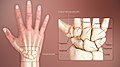 3D medical animation of human wrist showing carpal bones
 -
 Accessory carpal bones
 -
 Illustration of carpal bones from Braus 1921, figure 201
 -
 Illustration of carpal bones from Braus 1921, figure 210
 -
 Illustration of carpal bones from Braus 1921, figure 214


