Cell nucleus: Difference between revisions
CSV import |
CSV import |
||
| Line 26: | Line 26: | ||
[[Category:Cell anatomy]] | [[Category:Cell anatomy]] | ||
{{cell-biology-stub}} | {{cell-biology-stub}} | ||
== Cell_nucleus == | |||
<gallery> | |||
File:HeLa_cells_stained_with_Hoechst_33258.jpg|HeLa cells stained with Hoechst 33258 | |||
File:MouseChromosomeTerritoriesBMC_Cell_Biol6-44Fig2e.jpg|Mouse Chromosome Territories | |||
File:Diagram_human_cell_nucleus.svg|Diagram of human cell nucleus | |||
File:NuclearPore_crop.svg|Nuclear pore | |||
File:Micrograph_of_a_cell_nucleus.png|Micrograph of a cell nucleus | |||
File:Cajal-Body-Overview.svg|Cajal Body Overview | |||
File:Basic_diagram_of_a_transcription_factory_during_transcription.png|Basic diagram of a transcription factory during transcription | |||
File:RanGTPcycle.png|Ran GTP cycle | |||
File:Mitosis-fluorescent.jpg|Mitosis fluorescent | |||
File:redbloodcells.jpg|Cell nucleus | |||
File:Leeuwenhoek1719RedBloodCells.jpg|Cell nucleus | |||
File:Flemming1882Tafel1Fig14.jpg|Cell nucleus | |||
</gallery> | |||
Revision as of 12:17, 18 February 2025
Cell Nucleus
The cell nucleus is a membrane-bound structure found in most eukaryotic cells, which contains the cell's genetic material in the form of DNA. The nucleus is the largest organelle in the cell and is considered the control center of the cell as it manages the cell's functions and contains the majority of the cell's genetic information.
Structure
The cell nucleus is enclosed by a double membrane known as the nuclear envelope. This envelope separates the contents of the nucleus from the cytoplasm and is punctuated with pores that control the passage of ions, molecules, and RNA between the nucleoplasm and cytoplasm. Inside the nuclear envelope is the nucleoplasm, a gel-like substance that houses the chromosomes and nucleolus.
Function
The primary function of the cell nucleus is to control gene expression and mediate the replication of DNA during the cell cycle. The nucleus also regulates the growth and division of the cell. The nucleolus, a structure found within the nucleus, is involved in the production of ribosomes, which are then transported out of the nucleus to synthesize proteins.
Role in Disease
Changes in the structure and function of the cell nucleus can lead to disease. For example, mutations in nuclear proteins have been associated with a variety of diseases, including cancer, progeria, and Werner syndrome. Understanding the role of the nucleus in these diseases can provide insights into their mechanisms and potential treatments.
See Also
 | This cell biology article is a stub. You can help WikiMD by expanding the page. |
Cell_nucleus
-
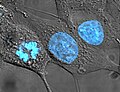 HeLa cells stained with Hoechst 33258
 -
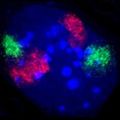 Mouse Chromosome Territories
 -
 Diagram of human cell nucleus
 -
 Nuclear pore
 -
 Micrograph of a cell nucleus
 -
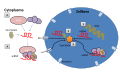 Cajal Body Overview
 -
 Basic diagram of a transcription factory during transcription
 -
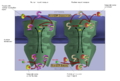 Ran GTP cycle
 -
 Mitosis fluorescent
 -
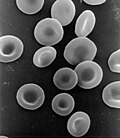 Cell nucleus
 -
 Cell nucleus
 -
 Cell nucleus


