Clavicle fracture: Difference between revisions
CSV import Tags: mobile edit mobile web edit |
CSV import Tags: mobile edit mobile web edit |
||
| Line 31: | Line 31: | ||
[[Category:Fractures]] | [[Category:Fractures]] | ||
{{orthopedic-stub}} | {{orthopedic-stub}} | ||
<gallery> | |||
File:Clavicle_Fracture_Left.jpg|Clavicle fracture on the left side | |||
File:Clavicle.gif|Animated depiction of a clavicle fracture | |||
File:Collarbone_fracture_-_Clavicle_fracture_1_--_Smart-Servier.png|Illustration of a clavicle fracture | |||
File:Clavicle_Post-op.png|Post-operative image of a clavicle fracture | |||
</gallery> | |||
Revision as of 05:01, 18 February 2025
Clavicle Fracture
A clavicle fracture, also known as a broken collarbone, is a common injury that occurs in the clavicle, one of the main bones in the shoulder. This type of fracture typically results from a direct blow to the shoulder, such as during a fall or a sports-related injury.
Causes
The most common cause of a clavicle fracture is a fall onto the shoulder or an outstretched arm. This can occur during various activities, such as cycling, football, and skiing. Other causes can include car accidents and, in newborns, the passage through the birth canal.
Symptoms
The main symptoms of a clavicle fracture include pain, swelling, and an inability to move the arm. There may also be a noticeable deformity or bump over the break. Bruising, tenderness, and a grinding sensation when the arm is moved are also common.
Diagnosis
A clavicle fracture is usually diagnosed through a physical examination and imaging tests, such as X-rays. In some cases, a CT scan may be used to provide more detailed images.
Treatment
Treatment for a clavicle fracture often depends on the nature of the fracture. Non-surgical treatment options include the use of a sling to immobilize the arm, pain medication, and physical therapy. Surgical treatment may be required for more severe fractures and can involve the use of plates, screws, or pins to hold the bone in place while it heals.
Prognosis
With appropriate treatment, most people with a clavicle fracture can expect to make a full recovery. However, complications can occur, including nerve or blood vessel damage, infection, and nonunion of the fracture.
See also
This article is a Orthopedic stub. You can help WikiMD by expanding it!
-
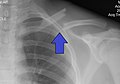 Clavicle fracture on the left side
 -
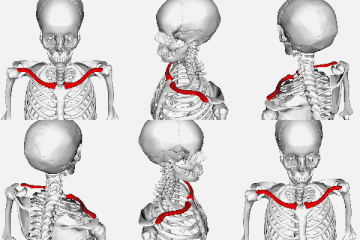 Animated depiction of a clavicle fracture
 -
 Illustration of a clavicle fracture
 -
 Post-operative image of a clavicle fracture


