Blitum bonus-henricus: Difference between revisions
CSV import Tags: mobile edit mobile web edit |
CSV import |
||
| Line 20: | Line 20: | ||
[[Category:Amaranthaceae]] | [[Category:Amaranthaceae]] | ||
{{plant-stub}} | {{plant-stub}} | ||
== Blitum_bonus-henricus == | |||
<gallery> | |||
File:Illustration_Chenopodium_bonus-henricus0.jpg|Illustration of Chenopodium bonus-henricus | |||
File:Plants_from_Passo_Pordoi_14.jpg|Plants from Passo Pordoi | |||
File:Blitum_bonus-henricus.jpg|Blitum bonus-henricus | |||
File:Chenopodium_bonus-henricus_sl1.jpg|Chenopodium bonus-henricus | |||
</gallery> | |||
Latest revision as of 21:35, 20 February 2025
Blitum bonus-henricus is a species of flowering plant in the family Amaranthaceae. It is known by several common names, including Good-King-Henry, Poor-man's Asparagus, and Lincolnshire Spinach. This plant is native to much of Europe and parts of Asia and North Africa. It is known elsewhere, including North America, as an introduced species and sometimes a weed.
Description[edit]
Blitum bonus-henricus is a perennial herb growing up to 70 centimeters tall. The leaves are up to 10 centimeters long and are arrowhead-shaped. The inflorescence is a dense spike of flowers. Each tiny flower is less than 2 millimeters wide and greenish or reddish in color. The fruit is a tiny, lens-shaped utricle containing a single seed.
Cultivation and uses[edit]
Blitum bonus-henricus has been cultivated as a vegetable in the past, although it is not much in use today. The leaves, shoots, and seeds of the plant are all edible. The leaves can be used like spinach, and the shoots can be treated like asparagus. The seeds can be ground into a meal and mixed with flour. The plant is also used as a medicinal herb.
See also[edit]
References[edit]
- Flora of North America
- Flora of China

Blitum_bonus-henricus[edit]
-
 Illustration of Chenopodium bonus-henricus
 -
 Plants from Passo Pordoi
 -
 Blitum bonus-henricus
 -
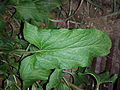 Chenopodium bonus-henricus


