Atmospheric pressure: Difference between revisions
CSV import Tags: mobile edit mobile web edit |
CSV import |
||
| Line 29: | Line 29: | ||
[[Category:Physics]] | [[Category:Physics]] | ||
{{atmosphere-stub}} | {{atmosphere-stub}} | ||
<gallery> | |||
File:Day5pressureforecast.png|Day 5 Pressure Forecast | |||
File:Mslp-jja-djf.png|Mean Sea Level Pressure (MSLP) for June-July-August and December-January-February | |||
File:Aircraft_altimeter.JPG|Aircraft Altimeter | |||
File:Storm_over_Snæfellsjökull.jpg|Storm over Snæfellsjökull | |||
File:Atmospheric_Pressure_vs._Altitude.png|Atmospheric Pressure vs. Altitude | |||
File:Plastic_bottle_at_14000_feet,_9000_feet_and_1000_feet,_sealed_at_14000_feet.png|Plastic Bottle at 14,000 feet, 9,000 feet, and 1,000 feet, sealed at 14,000 feet | |||
File:Wilma_2005-10-19_1315Z.jpg|Hurricane Wilma on October 19, 2005 | |||
File:Kochendes_wasser02.jpg|Boiling Water | |||
</gallery> | |||
Latest revision as of 11:37, 18 February 2025
Atmospheric pressure is the force per unit area exerted on a surface by the weight of air above that surface in the atmosphere of Earth (or that of another planet). In most circumstances atmospheric pressure is closely approximated by the hydrostatic pressure caused by the weight of air above the measurement point.
Overview[edit]
Atmospheric pressure is defined as the force per unit area exerted against a surface by the weight of the air above that surface. It is a fundamental concept in the fields of atmospheric science, meteorology, and physics. The standard atmosphere (symbol: atm) is a unit of pressure defined as 101325 Pa, which is equivalent to 760 mm Hg, 29.9212 inches Hg, or 14.696 psi.
Measurement[edit]
Atmospheric pressure is typically measured with a barometer. In a barometer, a column of mercury in a glass tube rises or falls as the weight of the atmosphere changes. Meteorologists measure atmospheric pressure in units of millibars (mb).
Effects on Weather[edit]
Atmospheric pressure plays a significant role in weather and climate. High pressure areas are generally associated with fair weather, while low pressure areas are associated with inclement weather. Changes in atmospheric pressure can often signal a change in weather.
Health Effects[edit]
Changes in atmospheric pressure can have noticeable effects on the human body. For example, rapid changes in pressure can lead to barotrauma, such as ear pain or more serious conditions.
See Also[edit]

This article is a atmospheric stub. You can help WikiMD by expanding it!
-
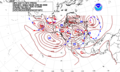 Day 5 Pressure Forecast
 -
 Mean Sea Level Pressure (MSLP) for June-July-August and December-January-February
 -
 Aircraft Altimeter
 -
 Storm over Snæfellsjökull
 -
 Atmospheric Pressure vs. Altitude
 -
 Plastic Bottle at 14,000 feet, 9,000 feet, and 1,000 feet, sealed at 14,000 feet
 -
 Hurricane Wilma on October 19, 2005
 -
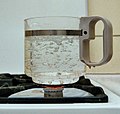 Boiling Water


