Aluminium hydroxide: Difference between revisions
CSV import Tags: mobile edit mobile web edit |
CSV import |
||
| Line 22: | Line 22: | ||
[[Category:Hydroxides]] | [[Category:Hydroxides]] | ||
{{Chemistry-stub}} | {{Chemistry-stub}} | ||
<gallery> | |||
File:Gibbsite-crystal-3D-balls.png|Gibbsite crystal structure | |||
File:Hydroxid_hlinit_.PNG|Aluminium hydroxide sample | |||
File:Bützflethermoor_Rotschlammdeponie_Luftaufnahmen_2012-05-by-RaBoe-478-1.jpg|Bauxite residue storage | |||
</gallery> | |||
Revision as of 04:19, 18 February 2025
Aluminium hydroxide is a chemical compound with the formula Al(OH)3. It is found in nature as the mineral gibbsite (also known as hydrargillite) and its three, much rarer polymorphs: bayerite, doyleite, and nordstrandite. Aluminium hydroxide is amphoteric in nature, i.e., it has both basic and acidic properties.
Chemical Properties
Aluminium hydroxide is a typical metal hydroxide. It reacts with acids to form salts and water, and with strong alkalis to form aluminates, with the evolution of heat. It also reacts with water to form aluminium hydroxide, Al(OH)3, which is an amphoteric species and can act as both an acid and a base.
Uses
Aluminium hydroxide is used in a wide range of applications due to its many properties. It is used as an antacid in medicine and as a mordant in dyeing processes. It is also used in water purification, as a fire retardant, and as a feedstock in the production of other aluminium compounds such as calcined alumina, aluminium sulfate, polyaluminium chloride, aluminium chloride, zeolites, sodium aluminate, activated alumina, and aluminium nitrate.
Health Effects
Ingestion of aluminium hydroxide can lead to constipation, and long-term use can lead to osteomalacia (softening of the bones). Inhalation of aluminium hydroxide dust can cause pulmonary fibrosis.
Environmental Impact
Aluminium hydroxide is not a hazardous substance. It is not expected to bioaccumulate, nor is it expected to have any significant impact on the environment when used in accordance with good manufacturing practice.
See Also

-
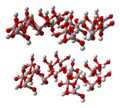 Gibbsite crystal structure
 -
Aluminium hydroxide sample
-
Bauxite residue storage


